The conditions are ripe for growing Black political consciousness, but revolutionary movements must broaden their reach to all sectors and classes of the people.
As the world has grown weary of the morally bankrupt and criminally insane shenanigans of the Trump administration, Democratic Party leaders have struggled to contain their glee. They smell blood in the water, and they lick their chops in anticipation of a proverbial “blue wave” of victories in the upcoming mid-term elections.
While the Democrats have felt a sense of euphoria as they have watched millions of people pour into the streets during “No Kings” protests, Party leaders most certainly have been alarmed by the overwhelming whiteness of the crowds. During elections, their campaign playbook demands the mass mobilization of voters of the African persuasion, and the absence of this demographic from public demonstrations against Trump is a red flag.
When there are concerns about Black voter turnout, in my imagination, the Democrats’ playbook says:
“Mobilize the Head Negroes in Charge. These include the Party sycophants, preachers who are parasites on the federal treasury, clueless podcasters and celebrities, and any others fitting the negroid profile who have the ear of their community. Next, direct these influencers to sound the alarm of an impending crisis in a way that will frighten Black people into running to the polls, where they will then cast their ballots for our beloved Democratic Party.”
U.S. Rep. James Clyburn of South Carolina has spent years studying the playbook, and he likely can recite its text verbatim. On cue and consistent with the book’s directive, he recently sounded the alarm when he said there should be less focus on the 2028 Presidential elections and more concern about Trump’s threat to voting rights during the midterm elections. “I’ve been saying to everybody, and I hope they take heed — 2028 is a very shiny object, 2026 is a necessary process. If we fail to conduct ourselves properly in these off-year elections, there ain’t gonna be a 2028 election,” Clyburn said.
Notwithstanding the dire warnings of an existential threat to democracy, the Democratic Party may find that increasingly, the Black community’s Pavlovian impulses have diminished and they are far less responsive to political alarm bells. A 2024 Pew Research Center study showed that: “… many Black Americans believe the racial bias in U.S. institutions is not merely a matter of passive negligence; it is the result of intentional design. Specifically, large majorities describe the prison (74%), political (67%) and economic (65%) systems in the U.S., among others, as having been designed to hold Black people back, either a great deal or a fair amount.”
These findings reflect an inevitable rise in consciousness that is the product of observation and lived experience over the course of decades. Having watched the machinations of both the Democratic and Republican Parties, the collective African mind has, in its brilliance, recognized that the political and other systems have “been designed to hold Black people back.” One consequence is that the people have withdrawn. Black people’s attempts to stop Trump in 2024 were a last-ditch effort to avoid the chaos we have experienced since Trump’s election, but their failure in the face of a tsunami of Make America White Again sentiments have led to a quiet abandonment of conventional political engagement.
These developments are of course disastrous for the Democratic Party. But given the dialectical relationship between the Democratic Party and the African World, what’s bad for the Democratic Party is good for Black people. A mass recognition of the antagonistic role of the political process represents a significant step forward for the Black community. It means they have been able to see through the symbolism of an Obama presidency and other propaganda, and to identify the system as hostile to their interests. But this development also means that the people have reached a crossroads where their selection of the wrong path can spell catastrophe. The hope is that they will choose to deepen their analysis and embark on a revolutionary course. But it is possible that in their efforts to rebuke the Democratic Party they will embrace destructive movements like Foundational Black Americans, or even worse, MAGA. They might also simply retreat into passive apathy with hopes that white folks’ ignorance and hatred will cause them to self-destruct.
There are conditions and circumstances that prompt an almost instinctive and intuitive revolutionary analysis. But such do not exist in the U.S. This country’s history is too complicated and the psyops that have been carefully designed to ensure mass ignorance and confusion have been too effective to presume that on their own, everyday people will gain an understanding of not only how capitalism uses white supremacy to oppress, but also why and how the system can be defeated. Consequently, there is the danger that even as Black people come to regard the political process as a dead end, that they will also become demoralized by the absence of a plan and vision for a liberating alternative.
Political education has long been a central programmatic feature of organizations on the Black Left. James Forman, an organizer with the Student Non-Violent Coordinating Committee (SNCC), explained that the organization’s participation in a Voter Education Project in the early 1960s was actually a disguised strategy to raise the level of revolutionary consciousness of the people – not for purposes of increasing their participation in the electoral process, but to inspire them to destroy it. Forman explained:
“SNCC’s goal was to lay bare the injustices perpetrated upon Black people – among them denial of the vote – in the hope that this would lead to greater mass action. In other words, we were interested in trying to register voters so as to expose the dirt of the United States and thus alienate Black people from the whole system. And the United States, through the Kennedy administration, was interested in trying to register voters for the sake of the Democratic Party. By cooperating with the Voter Education Project, sponsored by the Southern Regional Council with the federal government’s blessing, we saw a way to finance what we wanted to do. We would be walking a thin line of contradiction in the American system, but we felt able to do it.”
If the Pew study is correct, the challenge is no longer how to alienate the people from the system, but instead how to help them to understand the true causes of the alienation they already feel. It is also necessary to provide them with a revolutionary vision that makes sense. Unfortunately, too many of us have strayed from the organizing approach pursued by SNCC and many other revolutionaries around the world. Instead of finding ways to live and work with the people, too many create avant garde political organizations that spout esoteric jargon and host poorly-attended teach-ins where they tell themselves that the politically unenlightened not in attendance have missed out on the privilege of learning the correct political line.
There aren’t many everyday people who respond well to strangers who use strange language to communicate strange concepts and who invite them to meetings and programs about topics they know nothing about. They listen to people who they know and trust. SNCC understood this, and in the rural south their organizers sometimes traded in designer clothes for denim overalls, slept without complaint on the floors of small ramshackle homes and routinely shared meals of pinto beans and cornbread with families. Consider Kwame Ture’s comments from his book, Ready for Revolution, about his experience in Mississippi with his host family:
“I became close to the Johnson family, the parents, the grandmother, and the children. In fact, I felt like a family member, and all the Johnsons became stalwarts of the movement in Greenwood. Over the next four years, Mrs. Johnson would take care of a great many SNCC people coming through Greenwood. She always called me her son.”
As for the Johnson family, one of the children commented:
“But in spite of what his vocal was in terms of this and that in public, there was a certain way that [Ture] carried himself amongst the people. Stokely had a mild demeanor that he could sit down and be very patient, calm and talk through with ministers and what have you. But he wouldn’t accept to be disrespected, and then he didn’t allow you to disrespect local folk. He didn’t allow that. No, he didn’t… He was very much for the people…always.”
In 2026 it may not be useful for everyone to take up residence with southern sharecroppers, but if there is a genuine interest in providing people with a revolutionary political analysis, it still makes good sense to meet the people where they are and to become one with them. For the most part, people are not searching for revolutionary organizations to join. They are engaged in the work of traditional civil rights organizations, churches, Greek letter organizations, lodges, unions, neighborhood associations and social clubs.
The suggestion that revolutionaries join and work with these groups is sometimes met with a sneer by those who feel it is unthinkable that politically pure individuals will dare to lower themselves by mingling with bourgeois reformists. But such snobbery kills opportunities to explain to sororities that donate to charities in Africa that imperialism is why the continent is so poor in the first place. If the revolutionary doesn’t go to church, there won’t be an opportunity to explain to churchgoers that Jesus himself was an anti-imperialist whose insistence on equitable distribution of community resources inspired his followers to establish what was in effect a small socialist government. If the revolutionary doesn’t join the neighborhood watch program, there won’t be a chance to challenge the other members to consider that the street crime they hope to prevent is a byproduct of a capitalist system that causes desperation among those who endure extreme economic distress and emotional instability.
Political education is most effective when it is organic, and the fact that certain organizations don’t currently have a revolutionary program doesn’t mean that they don’t have revolutionary potential. During the early 1960s, Robert F. Williams, who was a militant internationalist, gave the NAACP a whole new look in his hometown of Monroe, North Carolina when he revived the local chapter. In his book Negroes with Guns, he explained:
“So one day I walked into a Negro poolroom in our town, interrupted a game by putting NAACP literature on the table and made a pitch. I recruited half of those present. This got our chapter off to a new start. We began a recruiting drive among laborers, farmers, domestic workers, the unemployed and any and all Negro people in the area. We ended up with a chapter that was unique in the whole NAACP because of working class composition and a leadership that was not middle class. Most important, we had a strong representation of returned veterans who were very militant and who didn’t scare easy.”
The conditions are ripe for explosive growth of the political consciousness of the Africans in this country. But if we decline to meet the people where they are because of fears of being identified as bourgeois reformists, then we risk missing an opportunity that may not become available again for quite some time.
Mark P. Fancher is an attorney and writer. He can be contacted at mfancher@comcast.net.




 The Bush administration had long planned a global war for U.S. hegemony, and the attacks of September 11 provided the perfect pretext to put those plans into motion.
 Oklahoma prison inmates were making political calls for a conservative Super PAC during the primary.
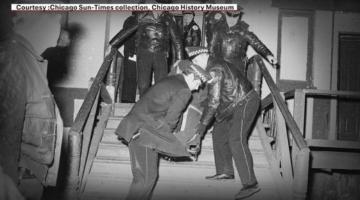 Longtime attorney Flint Taylor’s new book tells the story of the People’s Law Collective, which grew out of the radical movements of the late 1960s.
 The Trump administration has already cut off Cuba’s access to oil. Now it’s attempting to starve the Cuban people, targeting the country’s capacity to grow, process, and import food — unless it buys…
 Fergie Chambers is an American philanthropist who was arrested on July 10 in Ibiza, Spain, by order of the Trump Administration.


