The U.S. extradition request for Fergie Chambers is an attempt to use Spanish courts to extend a domestic campaign against political opposition.
The Spanish Council of Ministers has now authorized the U.S. extradition request for Fergie Chambers to proceed to the Spanish judiciary. This is not a decision to extradite Chambers. It is the next procedural stage.
Chambers was arrested by Spanish authorities in Ibiza, Spain, in July 2026 pursuant to the U.S. request. U.S. authorities accuse him of offenses including money laundering, conspiracy related to riots, and providing material support to Hamas. Chambers and his defense reject the allegations and maintain that funds in question were connected to humanitarian and political projects, including support for Palestine.
The case now moves before Spain's Audiencia Nacional, which will examine whether the extradition satisfies the requirements of Spanish law and the Spain–United States Extradition Treaty. If the court rejects extradition, Chambers cannot be surrendered to U.S. authorities. If the court finds the request legally admissible, the matter returns to the Spanish Government, which retains the authority to make the final decision. The extradition treaty itself contains a political-offense safeguard: extradition may not be granted where there are grounds to believe the request was made to prosecute or punish a person for a political offense.
But for the North-South Project for People(s)-Centered Human Rights (PCHR), the legal procedure is only the beginning of the question—not the end of it.
The PCHR Question: Is Law Being Used to Extend Political Repression?
The central issue is not whether the United States has constructed criminal charges that can pass the formal requirements of an extradition proceeding. The fundamental question: Is Spain being asked to use its sovereign authority to help extend an expanding U.S. campaign against political opposition beyond U.S. borders?
PCHR does not claim that political identification by itself establishes Chambers' or anyone else’s innocence. Rejecting the neutrality of law arguments, especially when law has been constructed by powerful social forces in unequal societies and unequal international power relations, the PCHR frame requires a different and more critical approach.
Political context matters when the requesting state has itself constructed a national-security framework in which political organizations, political networks, funders, nonprofit institutions and international relationships are increasingly treated as potential objects of investigation and disruption.
The Trump administration's National Security Presidential Memorandum 7 (NSPM-7) directs federal law-enforcement agencies to investigate and disrupt networks involved in what the administration describes as organized political violence. It also directs attention toward organizations, funders, nonprofit institutions, financial networks and U.S. citizens abroad. But only those with leftist political orientation. The memorandum specifically identifies anti-capitalism and other political currents among the ideological motivations to be examined.
That context cannot simply be removed from understanding the Chambers case.
Chambers is publicly identified with support for Palestine and “left” political issues. The prosecution therefore takes place within a broader political environment in which solidarity with Palestine, opposition to U.S. foreign policy, and organized left political activity are increasingly being brought into a repressive national-security framework.
For PCHR, this is the point at which a narrow state-centered conception of human rights becomes inadequate. A conventional extradition analysis asks whether the requesting state has met the formal requirements of the treaty. A people(s)-centered human rights analysis asks an additional question:
Whose political power is being protected, whose political activity is being criminalized, and what relations of power are being reproduced through the application of law?
This is not merely a theoretical concern.
In June 2026, the Parliamentary Assembly of the Council of Europe adopted Resolution 2669 on “Fighting back against transnational repression.” The resolution specifically identifies the misuse of extradition requests, INTERPOL mechanisms, mutual legal assistance, anti-money-laundering measures and counterterrorist-financing mechanisms as potential instruments of transnational repression. It warns that states which refuse to consider the political motivation behind abusive requests can become facilitators of transnational repression. It further calls upon states to consider a state's record of transnational repression when evaluating extradition requests.
This is directly relevant to the Chambers case.
The question before Spain is therefore not simply whether the United States has submitted a properly formatted criminal case. It is whether international legal cooperation is being transformed into an instrument through which political repression can cross borders.
PCHR has identified the United States as a state advancing an international fascist agenda whose domestic repression cannot be separated from its foreign policy of war, militarism, sanctions, racialized border enforcement, and support for Israeli state violence against the Palestinian people.
The repression of political opposition in the U.S. and the projection of U.S. power abroad are not unrelated phenomena. They are interconnected dimensions of the same imperial political order.
That is why the Chambers case matters beyond one individual. The danger is that political activity can increasingly be translated into criminal categories: solidarity can become “material support”; political fundraising can become “terrorist financing”; protest can become “organized political violence”; international political relationships can become evidence of conspiracy. This, as we know, has been done in the past.
What Anti-Imperialist and Anti-Fascist Activists Must Understand
In this period of globalizing fascism led by the U.S., human rights defenders must build independent power to counter the ongoing instrumentalization of international law through which powerful states pursue their political opponents across borders. The U.S. pursues Fergie Chambers using the weapon of law while it systematically dismantles the International Criminal Court (ICC) because the court finally was compelled to indict two war criminals from the fascist state of Israel. That is why the North-South Project for People(s)-Centered Human Rights cautions human rights activists in Spain to reject the conservative arguments legalizing procedural rules governing relations between states while ignoring the unequal relations of power in which those rules operate and the political context of consolidating global fascism led by the U.S.
The United States cannot be allowed to simultaneously characterize organized political opposition as a national-security threat and then demand that other states treat its prosecution of politically identified opponents as politically neutral.
Spanish authorities have an obligation to examine the charges against Fergie Chambers, but the political context in which those charges have been brought must be considered. The Chambers case is part of a much larger, and ongoing struggle over the meaning and application of international law and human rights in an era of lawless expanding war, occupation, militarization and fascism.
From a people(s)-centered perspective, the question is ultimately one of political power:
From its inception, international law has been used to advance the interests of powerful colonial/capitalist states against their political opposition and dominated states in the Global South. PCHR is not neutral. As a revolutionary frame, it demands that international law, like international human rights, must be transformed to represent the interests of peoples and nations of the world in struggle for a new world. Palestinian liberation is not a criminal offense. Those colonial/imperialist forces that conspire against Palestinian liberation are the criminals.
International law, once liberated, must serve peoples—not imperialism!
But in the meantime, we say, “Free Fergie Chambers.”






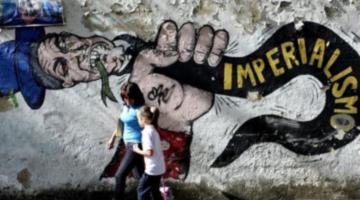
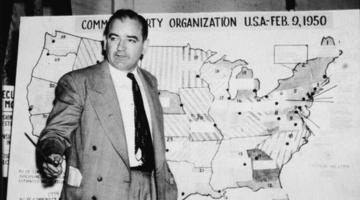 Red Scares are a recurring feature of the U.S. political tradition aimed at criminalizing anticapitalist politics through accusations of foreign infiltration and conspiracy. The NSPM-7 and the report…
 For several years, three landlocked West African states have undergone political transformations designed to turn the page on French neo-colonialism.
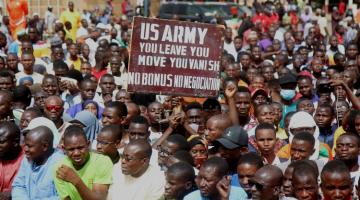 The U.S. is considering drone strikes and sanctions against the Alliance of Sahel States under the guise of counterterrorism, but the real objective is to regain neo-colonial control over Africa's…
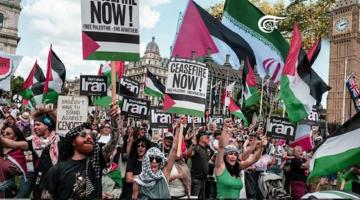 Western pro-Palestinian activism isolates Palestine from its regional allies, depoliticizing its struggle and reinforcing colonial divisions.
 The United Nations has adopted a resolution calling for the use of map projections that more accurately portray the size and proportions of the world’s continents, particularly correcting the long-…


