Amber Sherman, right, and Rachael Spriggs, left, protest during a special session of the state legislature to redraw U.S. Congressional voting maps in Nashville, Tenn. (George Walker IV. AP)
Tennessee just erased its only majority-Black voting district. Anger is justified but the deeper question is what Black people can do to gain and hold on to real power.
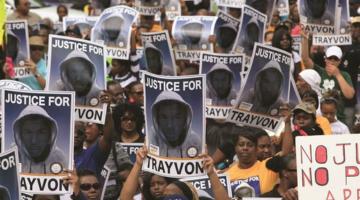
The militant reaction to the Tennessee legislature’s recent obliteration of the state’s only predominantly Black voting district struck an emotional chord with Africans throughout the U.S. Protesters crowded into the legislative chamber, chanting, waving placards, sounding air horns, and leaving no doubts about their anger. State Representative Justin Pearson then eloquently spoke for many when he said:
Today’s vote to redraw the congressional districts in Tennessee set our state back over 150 years. It was a political lynching that violated the rights of every Tennessean. This racist and reckless action was also an attack on Black political power that should appall everyone in the state, whether you are Black or not, a voter or not, live in Memphis or not, or are a Democrat or not.
The emotions fueling the protesters and countless other people across the country are rooted in subconscious if not conscious, memories of the experiences of African elders and ancestors in that state. It was in Tennessee where Diane Nash, John Lewis, James Lawson and many others waged sit-ins and launched freedom rides that prompted violent reactions by white racists, which caused much bloodshed. It was at Fisk University in Nashville that W.E.B. DuBois prepared himself for a phenomenal academic career that was to guide and inform Black resistance for generations. It was in Tennessee that an amazing, successful struggle was waged in the 1970s to prevent the demise of Tennessee State University when there were efforts to merge that HBCU into a predominantly white state university pursuant to desegregation mandates. It was in Tennessee, on a motel balcony in Memphis, that a bullet ended the life of our beloved champion and martyr, Dr. Martin Luther King, Jr., who was acting in solidarity with striking Black sanitation workers.
If not placed in a proper historical context, the ruthless attack by the Tennessee legislature on the reforms that elders and ancestors paid for with their blood induces a sense of nauseating dread and even a sense of hopelessness. But hope should spring eternal because the hand of the Lord rests firmly on Africans in the U.S. How else can the Black experience in this country be explained? Few, if any, communities have been the focus of such sustained and vicious attacks that have caused setbacks, but which have never resulted in defeat. In referencing that fact, Pearson boldly declared: "Today, you will take the only Black-majority district from us. But I want you to know: No matter what you do, no matter how much you try to break us and make us bend and quit — we will still be here."
Beneath the justified bravado is also a haunting question for which many have no ready answer. If the fight must go on, what is the pathway to victory? This is extremely concerning to a community that has invested an inordinate amount of its time, talent and treasure in the electoral process. Because practically all the Black community’s political eggs have been placed in a single electoral system basket, the loss of opportunities for strategic voting is comparable to taking the only available boat from a non-swimmer whose life depends on crossing a lake. In fact, the entirety of sanctioned political options available to Black people are tightly controlled by enemies who stand ready at any time to snatch away anything that might be effectively used to pursue liberation. Why then is there any reason to believe there is a way forward?
There are many who have recognized the political trap set for the Black community and they have not taken the bait. Like oppressed communities around the world they have struggled to become independent from their oppressors. Before his untimely death, Jackson, Mississippi, Mayor Chokwe Lumumba brought his commitment to Black self-determination with him into office, and began the process of implementing his plans for self-governing "people's assemblies" and a network of cooperative enterprises. In Michigan, the Detroit Black Community Food Sovereignty Network works to build community self-reliance through urban agriculture and cooperative buying. Community Movement Builders fights to establish self-determining communities through cooperative economic advancement and collective community organizing. In various parts of the rural south, there are new small farms worked by very young Black people who can sometimes be seen wearing dreads and African print smocks rather than bib overalls. There are also organizations that address many of the community needs that were the focus of the Black Panther Party's survival programs, including monitoring police operations. But while there is tremendous potential for the Black community to govern itself, ultimately, it lacks a strategy for defending itself from racist, capitalist aggression.
U.S. power is daunting, but the U.S. empire is not invulnerable. Whether in Vietnam, Cuba, the Sahel, or various other places, revolutionary forces with far less resources, power and influence have effectively resisted imperialism. Right now, the U.S. is getting whupped by Iran, and it’s worth examining how they are doing it because there are implications for the Black struggle in the U.S. It hasn’t mattered how many bombs the U.S. has rained down on Iran, it has forced the U.S. into practical submission because of one thing – the Strait of Hormuz. Iran’s stranglehold on this vital waterway has given that country a stranglehold on the U.S.
Africans in the U.S. and throughout the world desperately need something comparable to Iran’s control of the Strait of Hormuz. It need not be control of a waterway, but it must be control of something that can potentially inflict lethal blows on the U.S. political, economic or social systems. It is sad, bordering on pathetic, that within this country, Black people have fought, shed their blood and lost their lives to gain only reforms like the Voting Rights Act that can be, and has been gutted simply because it provided an opportunity for Africans to gain some measure of political influence. If the people are going to risk their liberty and lives for liberation, then it is only right that their struggle yields the capacity to say to all who dare challenge them: “Back off or we will destroy all that you hold dear!”
The idea of gaining true power and leverage for Africans is not new. In 1945, at a Pan-African conference in Manchester, England, serious consideration was given to prospects for the liberation of Africa from foreign control and the unification of the continent under a single socialist government. The realization of that vision would provide opportunities for Africans both on the continent and throughout the world to be able to meet any attack on Black safety, security or stability with a genuine threat to withhold Africa’s vast reserves of oil, gold, coltan, uranium, copper, chromium and much more.
If you think the loss of the Strait of Hormuz is giving the U.S. fits, the loss of access to Africa’s natural resources would cause capitalists everywhere to become positively apoplectic. The African World has been unable to gain control of its resources because western imperialism has been laser-focused on maintaining its greedy grip on the continent. The militarization of Africa through U.S. Africa Command (AFRICOM) has not been a charitable or benevolent enterprise. Likewise, it has been no coincidence that Congo, which may possess the highest concentration of mineral wealth anywhere, has been plagued by perpetual externally induced turmoil, which has made it easy for foreign corporations to engage in plunder with impunity.
As African Liberation Day fast approaches, there will be commemorative events all over the world. These gatherings will provide opportunities to have serious discussions about how to continue the intergenerational struggle to gain for Black people everywhere the leverage and power needed to force oppressors to back off and back down. This is not an objective that will be achieved in the near term. It is nevertheless an imperative, and we need look no further than Iran’s strategic use of the Strait of Hormuz to understand why.
Mark P. Fancher is an attorney and writer. He can be contacted at mfancher@comcast.net.








 In this week’s segment, we see through supposed disagreements between the US and Canada and recognize their partnership in settler colonialism, enslavement, and imperialism. But we begin with a…
 Joseph Kabila, former president of the Democratic Republic of Congo, named himself president of the Front for the Rebuilding of the Nation. He is now formally allied with M23, the Rwanda-backed…
 Isaac Saney is a Cuba and Black Studies specialist and historian at Dalhousie University in Halifax, Nova Scotia, Canada. He discusses the U.S./Canadian partnership in settler colonialism,…
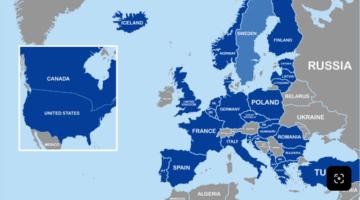 European puppet states have undermined themselves and their peoples' needs at the behest of the U.S. Now, that subservience may lead to war.
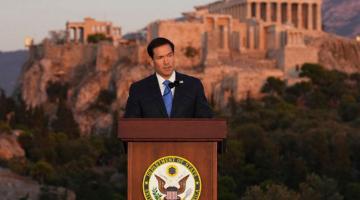 Marco Rubio's appeals to Western civilization, Christian heritage, and the defense of Western dominance are fundamental to the consolidating global fascist project, functioning to transform a crisis…


