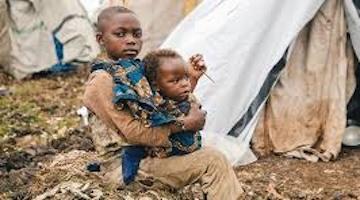
Tingi Tingi, a Rwandan refugee camp in DRC, then Zaire. On March 1, 1997, Paul Kagame's troops slaughtered its last occupants including children, women, and sick people who couldn't flee.
Rwanda’s 30-year Assault on the Democratic Republic of Congo, a new 80-page title from Baraka Books, gets straight to the essentials.
Judi Rever prefaces her new book with a simple quote from the Judgment of the International Military Tribunal at Nuremberg after World War II:
“To initiate a war of aggression is not only an international crime; it is the supreme international crime, differing only from other war crimes in that it contains within itself the accumulated evil of the whole.”
In the first chapter, “An Unjust War,” she makes it clear that the First Congo War, which began in October 1996, was not initiated only by Rwanda, Uganda, and Burundi, which invaded the Democratic Republic of the Congo, then Zaire, but also by the US. The US engineered and orchestrated this war in order to topple the aging and incompetent kleptocrat Mobutu Sese Seko, whom they had installed after assassinating Congo’s first Prime Minister, Patrice Lumumba. The Cold War was over and Mobutu was no longer useful.
“When the United States conducted covert regime change in Congo nearly three decades ago,” Rever writes, “it hid its role in ousting President Mobutu Sese Seko and installing a puppet regime loyal to Rwanda and its military leader, Paul Kagame.” The US and the corporate interests it represents had essentially anointed Kagame and his Tutsi elite to manage the exploitation of Congo’s vast resources for maximum profit.
However, the Rwandan refugee population was encamped in the way of Kagame’s progress through the jungle that separated Zaire’s eastern border with Rwanda and its capital, Kinshasa, near its Western border. The Hutu had historically aligned with Mobutu and besides, Kagame wanted them dead or driven back to Rwanda to die or be persecuted. He did not want them alive as refugees in Zaire or in host nations where they might speak to the crimes he had committed or organize to remove him from power, so his army set out to massacre them, ultimately chasing hundreds of thousands from east to west, leaving a trail of death and devastation.
US technology was used to commit the most horrifying human rights crimes, much as it has recently been in Gaza. Rwandan forces used “bait-and-kill” strategies to trap and massacre Rwandan Hutu refugees in the Congolese jungle.
Food and medical supplies that aid workers provided to refugees who were running away from Kagame’s soldiers were the bait. The soldiers used satellites to intercept the aid workers’ communications, locate Hutus in the jungle, then move in and massacre them. Most were too sick and weak to move anyway. Most of those who were able had struggled on ahead of them.
Kagame’s troops dug mass graves, but later unearthed the bodies and incinerated them to destroy the evidence of their crimes.
Aid workers, journalists, and Congolese people reported that this was happening, but US officials in the region looked away and claimed to know nothing. Rever pays particular attention to Robert Houdek, a diplomat with a long CIA history.
“I had no contact with the US military at all,” he told Rever. “What you’ve found out … I mean, I can’t comment on. I just don’t know anything about it. Were we happy to see the Mobutu regime depart? Yeah, along with the rest of the world.”
In other words, this was not a US regime change operation, but Rever clearly demonstrates that it was. Newsweek reported on Washington's machinations at the time, under the May 1997 headline “Washington’s African Move.”
Of course, US officials claimed to know nothing, writes Rever, because if their knowledge and collaboration were known, they could be held criminally responsible.
Many people know about Kagame’s crimes and Washington’s sponsorship, but none of it has ever been brought to where it belongs, the International Criminal Court.
After Zaire became the Democratic Republic of the Congo, the violence continued, and the resource exploitation began and then proceeded at a furious pace. One of the criminals, Bosco Ntaganda, was finally brought to the ICC to make it appear that the international community was finally doing something. Ntaganda identified as Congolese, but he was Rwandan-born and formally served under Kagame during the Rwandan War and Genocide. After settling back in eastern Congo, he became one of the region’s most powerful and ruthless warlords, surreptitiously serving under Kagame’s command.
The ICC at first indicted him as a Rwandan, but on his first day in court, Ntaganda stood up and swore he was Congolese, and the court simply accepted his testimony, to the outrage of the Congolese. The fact that he was part of Kagame’s network for stealing, smuggling, and selling Congolese minerals never became an issue before the court.
Rever goes deep into the crimes of Ntaganda, whom she calls the “nastiest of Rwanda’s warlords,” and the court’s cover-up in the name of justice.
“The court,” she writes, “which is often accused of being a political tool of the West, engaged in evidentiary omission, erasure, and obfuscation. Ntaganda was not a rogue warlord working on his own dime. His criminal godfather was the president of Rwanda, Paul Kagame.”
And of course, the court never worried that the US and its European allies enabled Kagame’s crimes for the sake of their corporations’ profits.
“The truth is,” Rever writes, “that the violent exploitation of Congo has been an economic engine for the developed world. For decades, international companies have engaged in illicit yet institutionally sanctioned trade of Congolese minerals that have been laundered by Rwanda, a country that faces no violent conflict inside its borders, where the roads are nicely paved and supply chain logistics are efficient.”
Rever’s book is an excellent primer for those who find the Democratic Republic of the Congo too distant and too complex for comprehension. Big bombs don’t fall from the sky, as they do in Gaza, and now Iran, and the press is only incidentally interested, so it’s easy to ignore. However, the human suffering is of no less magnitude, and the West bears no less responsibility. These 80 pages bring it all into sharp focus without overwhelming the reader with unfamiliar detail.
Ann Garrison is a Black Agenda Report Contributing Editor based in the San Francisco Bay Area. In 2014, she received the Victoire Ingabire Umuhoza Democracy and Peace Prize for her reporting on conflict in the African Great Lakes region. She can be reached at ann@anngarrison.com. You can help support her work on Patreon.


 October 7, 2023, was not an isolated attack, but the culmination of generations of Palestinian imprisonment and resistance in Gaza, comparable to Nat Turner's rebellion. History will record the Al…
 Julia Wright sent the following lightly edited message about protests in France on October 17, 2026, explaining the importance of immigrants in the movement, both today and in 1968.
 Disregard for Palestinian rights is a feature of Israeli politics rather than a bug. The upcoming Knesset election will change nothing for Palestinians, because every candidate across the political…
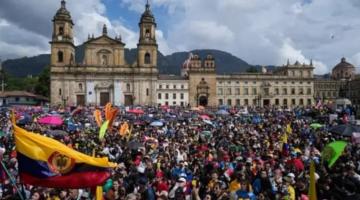 Thousands of people took to the streets across Colombia on Wednesday in the first national strike against President Abelardo de la Espriella’s administration, as police used tear gas, rubber bullets…
 As we are experiencing a world order in disorder, with war and conflagrations and a shifting balance of power, Issa Shivji calls for a Sovereign Pan-African Project. The analyses recap the…


