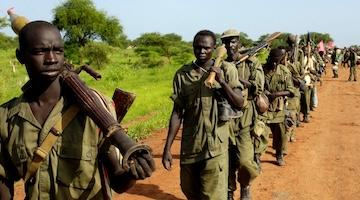
Sudanese army soldiers parade in the streets of eastern Sudan's city of Gedaref. (AFP)
The US and Israel’s wholly unprovoked attack on the sovereign nation of Iran has given Sudan a hand in their own battle for sovereignty.
Donald Trump doesn’t seem to have thought things through this week. Not that he ever does, but as Politico wrote today, he’s “running out of time to sell his rationale for the Iran war.” Was Iran on the precipice of building nuclear weapons or ballistic missiles or attacking Israel? Three-quarters of the American population don’t know or care, and he dragged us all into this as his MAGA Republican base was urging him to tend to domestic distress. They’re not the only ones who’ll be furious about the soaring price of gas and eggs and everything else come November, and he’ll all but surely be crushed in the midterms.
Another consequence he hadn’t intended is aiding the suffering Sudanese people. Last week I wrote about the humanitarian crisis they face, now widely agreed to be the worst in the world.
The Sudanese suffer much as Gazans do, but their numbers are far greater. The entire population is 52 million, and according to the UN Refugee Agency, 13 million have had to flee their homes. Roughly 4.5 million are refugees in neighboring countries, and roughly 8.6 million are internally displaced. One million refugees from neighboring countries were already living in Sudan prior to the civil war’s outset.
The displaced are eating insects, cow food, and hay, and dying of drone fire, gunfire, torture, and dengue fever.
Last week I also described the Stand Up for Sudan Act introduced in both the House and Senate with the goal of cutting US weapons sales to the United Arab Emirates (UAE) until it can demonstrate that it is no longer arming its proxy militia, the Arab-identified Rapid Support Forces (RSF), who are committing genocide against the African-identified people of Darfur, Sudan.
The RSF have also been looting and smuggling vast amounts of Sudanese gold to the UAE. Their commander, Mohamed Hamdan Dagolo, also known as "Hemedti,” has greatly enriched himself by this war.
General Abdel Fattah al-Burhan, commander of Sudan’s national army, the Sudanese Armed Forces, bears significant responsibility for the war's genesis and for crimes committed by his own forces. However, imperfect though he may be, he now stands for Sudanese sovereignty, the survival of the Sudanese state. If the Sudanese state survives, then the Sudanese people survive to fight another day and, hopefully, make the state serve their needs.
If the RSF wins, Sudan will become a de facto colony of the UAE and the US. If a ceasefire is declared with each of the two forces holding territory, the outcome will all but certainly be the second partition of Sudan, with the territory won by the RSF becoming a de facto colony of the UAE and US.
Last week I reported that passing the Stand Up for Sudan Act was a daunting challenge, especially given all the Trump family’s business ventures with the United Arab Emirates, but perhaps it is our only hope of stopping US weapons flows to the RSF via the UAE. Even if passed, the legislation contains provisos that would allow our president and those who have his ear to toss it out the window in the name of national security.
This week President Trump may have done far more for the Sudanese than that bill could ever have done by attacking Iran. Iran responded by firing missiles at every Gulf nation with a US military base, including the UAE, where most flights are now grounded.
“The longer flights in the UAE are grounded, the better for us,” said Sudanese Sovereign Media Editor Ahmed Kaballo. “No resupply for the RSF. It’s amazing.”
How much time does Sudan’s national army need? In April 2025, the Sudanese Armed Forces (SAF) and its allies regained control of the presidential palace in central Khartoum, the Sudanese capital, along with all the ministries and government buildings surrounding it.
Later that year the RSF seized full control of Darfur and actually filmed themselves committing atrocities with pride, to the horror of the outside world.
Three weeks ago, however, WarFronts reported that on January 26, the Sudanese national army liberated the cities of Dilling and Kadugli in South Kordofan, bringing relief to the people trapped there, and winning their greatest victories since reclaiming the capital a year before.
If the RSF’s supply lines remain cut much longer, the national army may be able to bring this horrible Sudanese war to a close.
Ann Garrison is a Black Agenda Report Contributing Editor based in the San Francisco Bay Area. In 2014, she received the Victoire Ingabire Umuhoza Democracy and Peace Prize for her reporting on conflict in the African Great Lakes region. She can be reached at ann@anngarrison.com. You can help support her work on Patreon.



 Mali, Burkina Faso, and Niger are leading the way toward the realization of Pan-Africanism and the struggle against imperialism in the 21st century.
 The 1976 bombing of Cubana Flight 455 was part of a six-decade U.S.-orchestrated campaign of destabilization against Cuba, which has now escalated into a genocidal siege aimed at starving the Cuban…
 While Trump pardoned an actual drug lord president, he keeps a kidnapped Venezuelan president, Nicolas Maduro, and his wife, First Combatant Celia Flores, in a mold-infested Brooklyn jail on false…
 Jeffrey Isaac Jarquin was deported from the U.S. by ICE and upon arrival in Managua was sent to prison by Nicaraguan authorities. Corporate media has decried the detention of a “torture victim” and “…
 In this week’s segment, we discuss student protests by Black and brown youth in France against austerity measures and race-based inequality in the education system. But we begin with a discussion of…


