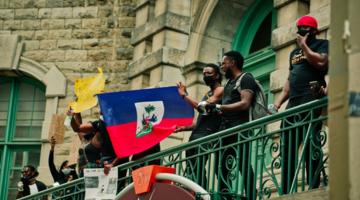
Since August 22, thousands of Haitians have been mobilizing across the country to protest against widespread insecurity, growing scarcity of fuel and the rampant cost of living crisis. (Photo: Jonas Reginaldy Y. Desroches/Twitter)
Haitians have been mobilizing against the Ariel Henry administration’s inability to combat crime, inflation and poverty. All of these ills are a direct result of Haiti's status as a puppet of the U.S. and its allies. The people are fighting for their sovereignty.
This article was originally published in Peoples Dispatch.
On August 29, in a new day of nationwide anti-government demonstrations, thousands of Haitians once again hit the streets in different parts of the country to protest against widespread insecurity, growing scarcity of fuel and the high cost of living.
In the town of Petit Goâve, in western Haiti, citizens held a massive demonstration demanding the resignation of Prime Minister and acting President Ariel Henry, arguing that during the past one year of his management, he exacerbated the economic, political and social crisis in the country.
According to reports from Rezo Nowdes, at least one demonstrator died after police launched tear gas at protesters in order to disperse them. The demonstrator was Roland Rathon, who was asthmatic and died from suffocation. Eleven other people were injured, including two with serious bullet wounds. The demonstrators put the responsibility for the violence on the security agents of the secretary general of the National Palace, Josué Pierre-Louis, who was visiting the region. Reportedly, several pro-government counter-protesters also threw rocks at protesters.
In the capital of Port-au-Prince, dozens of citizens staged a sit-in in front of Henry’s official residence, demanding that he step down. These demonstrators were also repressed and dispersed by the police with tear gas.
In addition to the sit-in, in Port-au-Prince, hundreds of protesters organized roadblocks with debris, erected barricades with burning tires, shut down businesses and marched through the streets in areas such as Champ de Mars, Delmas viaduct, Petion Ville, Nazon and Laule, rejecting soaring gang violence and high prices of essential commodities and basic services.
Since last Monday, Haitians have been mobilizing in the streets, criticizing the Henry administration’s inability to combat crime, inflation and poverty. On August 22, 23 and 24, under the banner of “Rise up for another independence”, members of several civil society organizations, popular movements, trade unions, opposition parties, and citizens in general organized different protest actions in Port-au-Prince, Cap-Haïtien, Petit-Goâve, Miragoâne, Les Cayes and Jacmel.
According to popular media platform Radyo Rezistans or Radio Resistance, during these three days of social protests, at least four protesters were killed and 19 were injured in police repression and in attacks by armed supporters of the Henry government.
Various social organizations and trade unions have called for nationwide mobilizations on September 4, and a general strike on September 5 and 6.
For the last four years, Haiti has been going through an acute social, political, institutional and economic crisis. The situation has worsened since the assassination of its de-facto president Jovenel Moïse in July 2021. Armed gangs have been increasingly seizing control of the national territory.
Violence and kidnappings have surged in Port-au-Prince and nearby areas in recent months, with warring gangs killing hundreds of civilians in their battles over territory. Reportedly, the gangs control nearly 30% of the national territory, and the clashes have caused more than 500 deaths since this April.
Poverty has also deepened, with inflation reaching 29%. The price of basic food products such as rice has quadrupled. Meanwhile, fuel remains the most scarce commodity. Service stations have been closed for months. In the illegal market, if available, petrol is sold at triple the price, costing USD$15 a gallon.




 Data fail to show that bail restrictions or any other reform fueled the spike in violence during the pandemic – but facts don’t matter to the corporate press
 The US clearly intends to justify yet another armed intervention in Africa in order to reinstate its former proxies in Ethiopia
 Miami serves as a heightened case to explore such contradictions as I look closely at tensions between African Americans, white Cubans, and Black Cubans.
 In typical critical analyses and progressive multiracial mobilizations Black suffering is acknowledged while antiblackness is negated
 Historian Elizabeth Hinton’s book reveals that, in the late sixties and early seventies, there were hundreds of local rebellions against white violence and racial inequality.



