The majority of residents in the hurricane-prone countries of the Caribbean are there as a result of a specific centuries-long crime wave, known as the Atlantic Slave Trade.
“The unfortunate victims should not be expected to bare the capital, recurrent, and other financial costs of rehabilitation.”
This statement is a personal one intended to support opinions, especially in the Caribbean, that the costs of practical recovery from annual hurricanes should not fall, as they mainly do, on the victims of these natural disasters. As it is, the pain, the agony, the distress, the abandonment, the unpredictable fatalities and other psychological costs of re-organizing and re-establishing their homes, their communities and their livelihoods are borne logically by the residents of the hurricane-prone countries. It is the argument of this statement that the unfortunate victims should not be expected to bare the capital, recurrent, and other financial costs of rehabilitation after these more and more ruinous disasters.
Before making recommendations, it is only fair to note that big-hearted, generous and humane individuals and institutions of other countries, often with no relationship to the victims, have always been ready to organize and deliver critical items and services to relieve the extremes of suffering. Our people will not forget these acts of generosity. In the case of the Bahamas, parts of which were devastated by hurricane Dorian, the assistance of the US Coast Guard was frequently noted in dispatches, an intervention which might have justly attracted the attention of the people of Puerto Rico. In a different mood, the United States civilian authorities received orders not to admit people in flight from the natural disaster, if they could not present visas and passports.
We now feel compelled once again, as a responsibility to history, to remind ourselves and the international community that the majority of residents in the hurricane-prone countries of the Caribbean, such as Bahamans, Barbudans, Haitians and others are there as a result of a specific centuries-long crime wave, known as the Atlantic Slave Trade. These Caribbean people are in the hazardous paths of these annual and all-powerful winds, now seen as growing in force and frequency, as global warming increases.
High Benefits With No Sense of Obligation
As a subset of the general demands for Reparations, the claims in this statement, made on European slave-owning of powers of the past, can be supported by repeating a selection of facts from world economic history:
- In the French empire, Haiti produced more revenue for France than any other possession owned by that nation.
- How Europe Underdeveloped Africa by Walter Rodney has laid bare the process by which one continent enriched itself at the expense of another.
- Looking back at the Atlantic Slave Trade, Karl Marx wrote in his classic enquiry that the entombment in mines of indigenous populations and the turning of Africa into a warren for the hunting of Blackskins marked what he called the “Rosydawn” of capitalist expansion.
- For a whole century, it was admitted that India was “the most precious jewel” in the British crown.
Against this background, this statement makes a very logical and human claim: The Caribbean countries randomly affected by hurricanes are populated by the descendants of people traded from the African continent, without any semblance of their consent. As one African woman poet puts it:
“We had no part in it
You brought us in your ship
You beat us with your whip …”
To make the lack of consent more emphatic, any attempt of the enslaved to escape from the plantations was punishable under the slave codes.
It is the argument of this statement, therefore, that the successor governments of the slave-owning empires cannot escape responsibility for the suffering and loss which the descendants of their captives experienced from natural disasters in countries to which their fore-parents had been forcibly transported.
Attempts of the enslaved populations to free themselves and claim rights as human beings were regularly answered by the dispatch of gunboats from the oppressor nations to reduce the rebels to submission. This in brief is the process by which the populations of the countries randomly assaulted by hurricanes have become sitting ducks to these natural disasters. Moreover, the economic frameworks into which the Africans, and later others, were entrapped proved in time unsustainable as the powers concerned and the USA conducted their economic rivalries. The cotton industry, the sugar industry, and the banana industry are examples of how several Caribbean populations have been forced to experience a loss of economic security and have been left to survive mainly by their own devices.
Decades ago, the Working People’s Alliance, as an organization outside of government, had proposed publicly that small disaster-prone countries should be protected by a new kind of multi-lateral Insurance Scheme from the injustice of bearing the cost of rebuilding and rehabilitation after a disaster. The recommendation fell on deaf ears. Since those years, the problem has become more acute, as carbon emissions increase and render hurricanes more destructive.
“The successor governments of the slave-owning empires cannot escape responsibility for the suffering and loss which the descendants of their captives experienced.”
The present personal statement is made in the hope that although it does not come from an organization, it can be the subject of critical study, leading to action that places responsibility where it really belongs, at the feet of the European Empires referred to above. It is hypocritical and impractical for the successor governments of the slave-owning powers to expect CARICOM and its citizens to muster the resources to respond to these calamities. On the other hand, for CARICOM to aspire heroically to assemble the human resources, the financial resources and the hardware necessary in these emergencies is a serious misunderstanding, exaggeration and distortion of the principle of self reliance.
1. Since the slave-owning powers had assumed the super-human right to deploy populations from their natural homes, their successor governments should consider themselves mainly liable.
2. Since the hurricane season can be accurately predicted, it is not too much to ask that the governments concerned anticipate the needs of the hurricane-prone countries and deploy peace ships with necessary forms of relief to strategic locations in the region on a precautionary basis to make timely delivery of search and rescue and relief in the affected countries at the earliest possible moment. In the same spirit and as advised by CARICOM or any other empowered regional organization, they should be ready to assist in the transport of medical and other service volunteers to the affected locations with as little delay as possible.
In making this statement, my purpose is clearly not to assign to the slave-owning powers and their successor governments any guilty knowledge of all the results of their expansionist activities of the centuries after the invasions of Columbus. Rather, the purpose of this statement is to apply the standards of judgment of the present day and the 21st century to argue that they cannot escape the moral responsibility for the consequences of their self-serving and inhuman population transfers, and that it is time to apply adequate reparatory measures.
Eusi Kwayana is a native of Guyana living in Atlanta, Georgia.
COMMENTS?
Please join the conversation on Black Agenda Report's Facebook page at http://facebook.com/blackagendareport
Or, you can comment by emailing us at comments@blackagendareport.com

 "United Nations Negroz" is the latest poem from our Poet-in-Residence, Raymond Nat Turner.
 From the moment the first colonizers arrived in the Caribbean, the West has treated the region as a treasure chest for resource extraction and labor exploitation.
 The state uses tactics such as medical neglect, to slowly assassinate political prisoners like Mumia Abu-Jamal.
 It is prudent for Black people to join in coalition with the Arab and Muslim people collectively refusing to support President Biden and connect the struggle for Palestinian liberation to the…
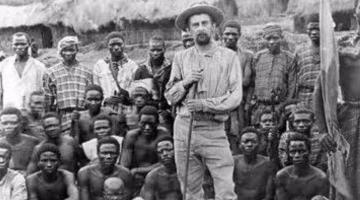 From the decline of the triangular trade to the rapacious extraction of mineral resources and labor exploitation, Africans have organized and revolted against western domination.


