Click the flash player to listen to or the mic to download an audio in MP3 format.
“Stop-and-frisk is the race-based law of the land, the American police state in its most elemental, predatory form.” In cities across the nation, police stops of Blacks and Latinos have doubled, tripled and, in New York City, sextupled since 2002. In public housing, police stops are three times more frequent than in surrounding neighborhoods with the same rates of crime.
On Black Streets and Public Housing, Bill of Rights is Dead Letter
A Black Agenda Radio commentary by Glen Ford
“Public housing tenants in New York are three times as likely to be stopped in their own complexes than people in surrounding neighborhoods with similar crimes rates.”
When many Americans use the terms “police state” or “creeping fascism,” their point of reference is the Patriot Act or some other mechanism of the national security state. But for Black America, the police state is the daily reality of arbitrary, relentless stops on the streets of their own neighborhoods, or in the hallways of their own public housing projects.
When the numbers are tallied, they are expected to show that more than
600,000 people were stopped by police on the streets of New York City, last year, 89 percent of them Black and brown. That’s almost six times the number of “stop-and-frisks” in 2002. Philadelphia stopped 200,000 people on its streets in 2008, twice the number as in the previous year. Los Angeles stop-and-frisks hit a quarter million in 2008, double the rate in 2002. And that doesn't count the people stopped in their cars in L.A.
Stop-and-frisk is the race-based law of the land, the American police state in its most elemental, predatory form, a system of methodical mass racial profiling that debases and criminalizes all African Americans, and which now serves as the primary intake mechanism for the national policy of mass Black incarceration.
The legal justification for the mass stopping and frisking of Blacks roughly dates to the beginnings of modern mass imprisonment of Blacks. In 1968, the U.S. Supreme Court ruled that police can stop and detain citizens based on “reasonable suspicion” of involvement in crime, rather than the higher standard of “probably cause.” Of course, in a racist society, singling out Blacks for more intensive surveillance and questioning seems eminently reasonable. And when mass Black profiling ultimately results in far more Blacks being sucked into the criminal justice system, then the racist society concludes it was right all along – that African Americans are more prone to commit crimes. Mass Black profiling is guaranteed to find what it's looking for: more Black crime. Mass Black profiling and mass Black incarceration are organic elements of the same, diabolical system that preys on African Americans as a group and makes the words “crime” and “Black” synonymous in the public mind.
“Mass Black profiling is guaranteed to find what it's looking for: more Black crime.”
Nowhere is police predation more merciless than in public housing. New York City public housing is home to 400,000 people, 95 percent of them Black and Latino. The NAACP Legal Defense and Educational Fund has filed suit, charging that police so-called “
vertical sweeps ” from floor to floor of public housing buildings serve no legal purpose, and routinely subject residents and visitors to illegal stops and false arrests. Studies have shown that public housing tenants in New York are three times as likely to be stopped in their own complexes than people in surrounding neighborhoods with similar crimes rates. Police stops have doubled in public housing since 2004. Visitors are so harassed and intimidated by police behavior, many no longer visit their friends and relatives in public housing. The citywide public housing tenant organization says the perception among residents is that they are living in “penal colonies.” For millions of Black Americans, the Bill of Rights no longer exists on the streets and in the hallways of their city. For Black Agenda Radio, I'm Glen Ford. On the web, go to
www.BlackAgendaReport.com .
BAR executive editor Glen Ford can be contacted at Glen.Ford@BlackAgendaReport.com.

 This week the U.S. state’s propaganda and the Black elite were on your minds.
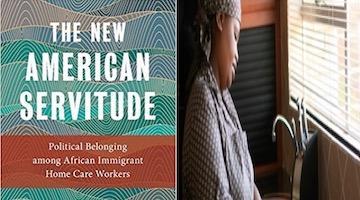 Senior care puts care workers into racialized, gendered, and age hierarchies, making it difficult for them to achieve social and economic mobility.
 I am hoping my call will provoke/inspire us to practice forms of life and liveliness differently.
 While Biden is telling Haitians “Don’t come over,” Haiti and its allies have been saying “U.S. Out of Haiti.”
 The author unpacks the tired trope of “poor rich Haiti,” highlighting the role of foreign capital and local elites in the destruction of life in the countryside.



