Israel has banned all humanitarian aid, including food and medicine, from Gaza since 2 March. (Omar Ashtawy / APA Images)
Israel has violated its ceasefire agreement with Hamas. But Israel never truly adhered to it, instead choosing to continue its genocidal policies.
Originally published in Electronic Intifada.
The following is from the news roundup during the 13 March livestream. Watch the entire episode here.
In Gaza, Israel’s closure of all crossings has continued for almost two weeks. Palestinians are reporting severe water and food shortages as Israel uses starvation as “a weapon of genocide,” as the rights group Al-Haq stated.
“Israel’s decision to re-impose a total blockade of all humanitarian aid entering the Gaza Strip, particularly during the month of Ramadan, is yet another example of Israel violating the ceasefire agreement and provides further proof of its manifest intent to eliminate Gaza’s population by creating conditions of life calculated to bring about their destruction, in continuing breach of provisional measures of the International Court of Justice,” Al-Haq added.
The Palestinian Non-Governmental Organizations Network and the Association of International Development Agencies declared in a joint statement that the 19 January ceasefire “provided a brief window for humanitarian operations to scale up. In just six weeks, aid organizations delivered food and medicine, reopened medical facilities, and launched vaccination campaigns.”
During this period, the groups stated, “humanitarian actors demonstrated that when they are finally given an enabling environment, they can do their jobs and deliver. And Israel proved that enabling the delivery of aid was only a matter of will, a reality it has now underscored by choosing to use humanitarian aid as a negotiation tactic.”
The aid group Islamic Relief stated on 11 March that “aid trucks loaded with food and other essential aid are ready and waiting to enter Gaza but are being blocked just a few miles from desperate civilians.”
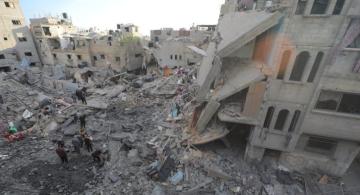
Gaza’s entire infrastructure has been systematically destroyed by Israeli attacks, including its ability to feed itself, the organization added.
“More than 80 percent of Gaza’s agricultural land and more than two-thirds of its agricultural wells have been damaged or destroyed, and most cattle have been killed, leaving families in Gaza now almost entirely dependent on imported supplies. The scarcity has caused prices in local markets to skyrocket, making even the most basic necessities unaffordable for the poorest and most vulnerable.”
In a joint press briefing of UN experts in Geneva, Switzerland, on Wednesday, Michael Fakhri, the special rapporteur on the right to food, asked, “How is Israel able to starve 2.3 million people so quickly and so completely? This is the fastest starvation campaign in modern history.”
Fakhri added that with Israel’s resumption of the blockade on Gaza, “this is not a ceasefire by any definition. This is a slowing down of military violence, but … an unfolding of death through starvation.”
He called for immediate and complete economic, political, diplomatic and cultural sanctions on Israel to stop the genocide, as well as wide-spectrum reparations for Palestinians.
Compounding the crisis, Israel’s ministry of energy and infrastructure announced that it was immediately cutting off the last remaining supply of electricity to Gaza on 9 March. Gaza has been under a mass electricity blackout since October 2023, except for the south Gaza desalination plant which was reconnected to the electricity grid in November 2024, according to the United Nations.
The UN children’s fund UNICEF said on 11 March that only one in 10 people in Gaza are currently able to access safe drinking water and that the situation has worsened after Israel’s electricity cut.
The Gaza government media office condemned Israel’s latest and ongoing cuts to electricity for Gaza.
The continuation of these punitive policies against civilians, the media office stated, “constitutes a flagrant violation of international humanitarian law and exacerbates the suffering of the residents of Gaza, who are facing the worst humanitarian crisis in history. The denial of entry of construction materials, spare parts, machinery, and alternative energy systems has limited the municipalities’ ability to find effective solutions, deepening the crisis and threatening the collapse of basic services.”
Three Palestinians killed every 24 hours
Meanwhile, Israel continues to kill Palestinians in Gaza in spite of the apparent ceasefire.
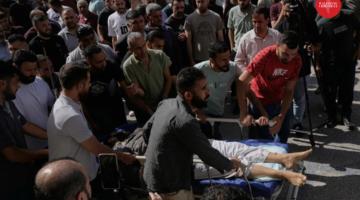
On Tuesday, Israeli forces attacked an area near Gaza City, killing at least six people in drone strikes near the former Netzarim corridor.
An Israeli drone killed a Palestinian woman east of Rafah in the south, and Israeli soldiers shot and killed a Palestinian girl in Deir al-Balah in central Gaza, according to Al Jazeera. Israeli forces also opened fire on homes in Khan Younis.
Euro-Med Human Rights Monitor stated on 11 March that Israel has killed an average of three Palestinians every 24 hours since the ceasefire.
“The ongoing killings by the Israeli army are carried out by snipers and drones, including quadcopter aircraft, which target Palestinian civilians in the Gaza Strip. The deadly attacks frequently occur when residents attempt to return and inspect their damaged homes near the so-called ‘buffer zone’ imposed by Israel along the Strip’s northern and eastern borders,” Euro-Med said.
The Rafah governorate has faced the most Israeli targeting since the ceasefire, the human rights group added.
Our contributor Abubaker Abed reported that Israeli troops in western Rafah were firing at several areas and in places where Palestinians were gathering, and that Israeli tanks were just a few meters away from displaced families sheltering there.
Field hospital offers basic care
Nearly three months after the Kamal Adwan Hospital in the northern city of Beit Lahiya was raided and destroyed by Israeli soldiers, medical staff have set up a field hospital in the ruins of the hospital compound and are operating with minimal resources.
The head of Kamal Adwan’s obstetrics and gynecology department told Al Jazeera that there are severe shortages of medical and nonmedical supplies and tools and they are forced to care for their patients, including pregnant women, with only basic care.
The UN agency for sexual and reproductive health warned this week that the ongoing blockage of aid entry into Gaza is jeopardizing progress made since the ceasefire in terms of expanding sexual and reproductive health services and scaling up gender-based violence prevention, mitigation and response.
The agency also stated, “Compounded by widespread uncertainty and loss, the psychological toll [of the last 17 months of war] has further deepened people’s vulnerabilities, increasing the risks of life-threatening pregnancy and childbirth complications.”
Israel kills grandmother in occupied West Bank
Turning to the occupied West Bank, Israeli army raids and intensified settler-colonial violence have continued in the northern region for more than 50 days, and where more than 60 Palestinians have been killed.
The Palestinian health ministry stated that the Israeli army stormed the eastern and western neighborhoods of Jenin city on 11 March. Soldiers forced residents in an apartment building to leave, detained them and interrogated them, and ransacked apartments.
Israeli forces killed at least four people in Jenin on 11 March, including a 58-year-old grandmother, identified as Faiza Ibrahim Abu Ghalil.
Israeli soldiers have continued to raid and attack areas in Tulkarm and the Nur Shams refugee camp. The Wafa news agency reported that on 12 March, occupation forces deployed foot patrols around the camp while bulldozers leveled another stretch of the street adjacent to its entrance, destroying infrastructure and civilians’ property.
Meanwhile, Tulkarm camp saw a heavy presence of military vehicles and infantry units. Israeli forces set fire to homes in the camp at night on 11 March.
On 7 March, Israeli forces also stormed the ancient al-Nasr mosque in Nablus, reportedly setting fire to sections of it.
The Associated Press reported that when asked for comment, the Israeli military said it was “not aware” of any fire set by soldiers at the site.
Ghassan Daghlas, the governor of Nablus, told the agency, “They want to destroy the West Bank, Gaza, and everything, but the important thing is the resilience, the resistance, and staying on our land. … We will rebuild in the early morning. We will restore prayer to al-Nasr mosque.”
And for the second time in a month, Israeli police again raided the Educational Bookshop in occupied Jerusalem.
Police arrested an owner, Imad Muna, and confiscated dozens of books, according to Imad’s son, Ahmed.
The Wafa news agency reported, “After an hour and a half of conducting a raid of the shop, once again using Google Translate to discern the meaning of the titles on the shelves, the occupying forces confiscated dozens of books, arrested the owner, and took him to the Israeli police station” nearby.
Included in the stack of books that were seized were authored by Ilan Pappé, Noam Chomsky, Jonathan Cook, Steven Salaita, and The Electronic Intifada’s Ali Abunimah and Nora Barrows-Friedman.
The Israeli police told media that it had “received a report from a caller who stated that he had observed books containing inciting content at a bookstore in Jerusalem.”
Imad Muna was eventually released, and most of the books were returned except for three, according to Ahmed Musa, a co-owner of the bookstore and Imad’s son.
The Israeli police said that they have “initiated a review of the books, and based on the findings, a determination will be made on whether to refer the matter to the State Attorney’s Office for further investigation into the suspected sale of inciting materials.”
Highlighting resilience
Finally, as we always do, we wanted to share images of people expressing determination and resilience across Palestine.
In Gaza, Samih al-Madhoun, a young musician, performs the song “Yamma Hadu Darna” by artist Omar al-Abdallat while sitting atop rubble. The lyrics of the song include “O, mother, they destroyed our home, my brother’s and my neighbor’s home, don’t be sad, O mother, we have gained more stones.”
Nora Barrows-Friedman is a staff writer and associate editor at The Electronic Intifada, and is the author of In Our Power: US Students Organize for Justice in Palestine (Just World Books, 2014).





 As the empire crumbles, the neoliberal capitalist order run by a corrupt duopoly is working to silence dissent. The Black left, of course, is always the first target.
 A reminder of when Accra was at the center of struggles against nuclear imperialism. African people have always been at the forefront of peace and sanity.
 I spoke to Maurice Carney, Executive Director of Friends of the Congo, about the virtual slave labor in the cobalt mines of the Democratic Republic of the Congo’s cobalt mines.
 Seven months in, and in the face of brutal state repression, the people of Peru continue their struggle against the neoliberal dictatorship of the Boluarte coup regime.