The Israeli murder of heroic Palestinian journalist Anas Al-Sharif was bookended by accusations that he was part of Hamas. For many of our allies, the instinct is to prove his innocence by proving him “unaffiliated.” The following text, an excerpt from a previously published work, is a commentary on that impulse.
Originally published in Mohammed El-Kurd.
The invention of the civilian as a “nonpartisan,” “neutral” figure has exacerbated the depoliticization of the Palestinian cause. To be deemed a civilian necessitates that we exist in a mythological dimension where we are without perspective. Our cause, as imagined in this mythology, is no longer understood as a liberation struggle but as a “humanitarian crisis,” where revolutionaries are not part and parcel of our nation, motivated by political aspirations and dreams of emancipation. Instead, they are interpreted as rogue actors senselessly wreaking havoc to the dismay of helpless bystanders—the disinterested women and children, the impartial paramedics and journalists.
In such ahistorical readings, which obfuscate the power imbalance between the occupier and the occupied, the militant is evacuated outside of the context that gave rise to him or her in the first place; the newscaster is expected to present the killing of her siblings as if she were an unbiased observer; and the nurse whose patient is a beloved coworker maimed by an airstrike is expected to maintain “professionalism,” to not seek revenge on the drone operator.
Of course, in Palestine, like everywhere else, there are individuals who are or define themselves as “apolitical.” There are, one could argue, medics who think all parties are to blame, journalists who believe in the myth of objectivity instead of satirizing it. But “neutrality” is not an indicator of innocence, nor does it guarantee safety. In fact, what unites the nonpartisan and the partisan, or the partisan by association, is their susceptibility to settler violence. The difference is, we seem to only run to the rescue of those perceived to be apolitical. When the affiliated (or the allegedly affiliated) are a target, we first try to negate their alleged affiliation before we respond to their calls.
Some months into the ongoing genocide in Gaza, which is “the deadliest conflict for journalists in recent history,” the Israeli occupation forces openly considered journalists employed by media organizations associated with or run by Hamas “to be legitimate military targets.” A senior spokesperson for the IOF went as far as telling reporters that “there was ‘no difference’ between working for [Al-Aqsa TV] and belonging to Hamas’s armed wing.” This statement brings to mind another comment by a different military spokesman, who said the late Shireen Abu Akleh was “armed with [her] camera.” It also brings to mind a Jewish Insider headline that reads, “One-Third of Journalists Killed in Gaza Were Affiliated with Terrorist Groups.” A headline where journalists justify killing journalists.
The instinct of many defenders of Palestinians is to dispel the connection between the slain Palestinian media workers and their supposed political leanings, as if anywhere in the world these exist in isolation. While it is demanded of us to distance ourselves from the guerrilla fighters struggling against colonialism and occupation, Zionist soldiers—the colonizers and occupiers—can work, without much irony or scrutiny, in newsrooms and in media watchdog organizations. Take, for example, Axios’s political reporter covering Israeli affairs, Barak Ravid, who was, until March 2023, a reservist in the Israeli occupation forces while working for an international media outlet. Or the editor-in-chief of the Atlantic, Jeffrey Goldberg, who dropped out of his American university to volunteer in the IOF during the First Intifada, then, during the course of his job as a so-called prison counsellor at the notorious Ketziot camp, lied to cover up for a friend whom he witnessed beating a prisoner. Correspondents entangled with the Israeli army are not challenged on the basis of proximity to “the conflict,” let alone condemned to die because of their participation in or fondness of the Israeli military apparatus. They do not need to be humanized.
Indeed, they are often more than merely human; the New Yorker had no reservations in quoting what it called a “lefty” journalist who lauded the IOF soldiers waging the genocide in Gaza with the words “they are our children. . . . They are us.” If you are a New York Times correspondent in occupied Jerusalem, as Isabel Kershner was, with two sons in the IOF, how does that influence your reporting on “the conflict”? If your spouse’s professional duty was “shaping a positive image of Israel in the media,” as program director at the Institute for National Security Studies (INSS), the settler state’s “leading security think tank,” as was Kershner’s husband’s,* how can you maintain impartiality as a reporter? “An examination of articles that Kershner has written or contributed to since 2009 reveals that she overwhelmingly relies on the INSS for think tank analysis about events in the region.” Examples of reporters having direct ties to the entity waging the genocide against the Palestinian People are numerous. As for Palestinians—we are held to a completely different and impossible standard.
It is not enough for a Palestinian to be a journalist to be deemed human; they must be “unaffiliated.” Otherwise, in accordance with Zionist logic, they cannot be grievable or included in the official death toll; slaughtering them is cause for celebration. Such an unfeasible demand of “no affiliation” fragments Palestinians further: we are not only divided based on colonial borders and invented geographies, but even within a single profession we are split into legitimate and illegitimate targets. This has created a reality in which the Palestinian People are pitted against each other; some of us work for reputable, foreign agencies, others work for local ones, “Hamas-run.” As a result of this indictment, we look for the exceptional, and we cite it.
And when I say “we,” I implicate myself in this critique. When I wrote about Palestinian martyr Omar As‘ad, I wasted some time searching for reliable sources that proved the soldiers had beaten him. Something, perhaps a deeply seated, learned behavior or a pervasive, subconscious impulse, told me it was not enough that he had been left to die in the cold—bound, gagged, and blindfolded. He needed to have been beaten too. Despite the entire argument I am agonizing over, I sifted through articles in an attempt to editorialize his killing with another layer of brutality. But when we do what we do to Shireen Abu Akleh, to Omar As‘ad, to Hind Rajab, to Mohammed Abu Khdeir, when we do it out of love, out of a desperate desire to legitimize mourning them, we are inadvertently reifying the colonial rationale that killed them and rendered them killable in the first place.

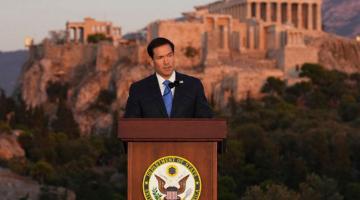 Marco Rubio's appeals to Western civilization, Christian heritage, and the defense of Western dominance are fundamental to the consolidating global fascist project, functioning to transform a crisis…
 “So we started to preach the doctrine of self-organization. And we made it very clear what we were after — the genuine multiracial and democratic power of the working people.”
 Trump is terrorizing Minnesota’s Somali Americans in a desperate xenophobic and racist appeal to voters in the state’s white farming and mining communities.
 Artificial intelligence and hyperscale data center buildout constitute a new front of environmental racism and a project to optimize white supremacy, with Black communities targeted as sacrifice…
 Erik Prince's mercenary operations in the Democratic Republic of the Congo serve U.S. imperial and corporate interests in critical minerals and violate the Congolese peoples' sovereignty.


