Corporate media require American identity politics which contradict African authenticity.
Authentic Black voices are dangerous to this system. America allowed them to be heard for a moment in the 1960s and 1970s because the powers that be expected militants’ incendiary rhetoric to frighten quiet Negroes. However, much to the establishment’s surprise, the people were roused into righteous Black Power fury.
America learned its lesson well. It denied the militants media access, but in an effort to preserve the illusion that this country is a marketplace of ideas, it groomed a cast of Africans who talk tough, bark loud, but never bite. These are the safe Black pundits who lend their talking heads to television news panels that engage in superficial to false analysis of unfolding world events. They include Black right wing buffoons like Tim Parrish and Shermichael Singleton, as well as so-called liberals like Van Jones. Their objective? Never say anything inconsistent with the capitalists’ political interests as framed by the Democratic and Republican Parties.
Of even greater significance is the dynamic that exists between right wing white male panelists and some Black pundits who are sincere in their defense of their community, but who naively swear total allegiance to the Democratic Party. Blowhard white men like Scott Jennings, Ben Ferguson and Kevin O’Leary arrogantly command attention during the televised debates by simply being present. Without apology they spew idiocy to their hearts’ content leaving the other panelists to scream at them with frustration and outrage.
The more agitated the Black panelists become, the more the white men gaze at them with smug satisfaction. And it doesn’t stop there. While the white pundits double down and dig in their heels, their fellow Black panelists engage in a desperate effort to find agreement or common ground regarding, if necessary, the most insignificant of matters. The one thing that cannot happen is for the debate to end without the white men having been at least minimally appeased.
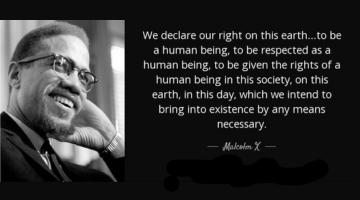
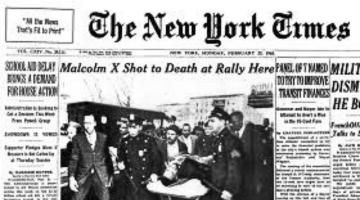
The idea that an African must present his or her most code-switched self when showcased in national media has not been embraced by those who speak with authentic Black voices. Consider Malcolm X. During a televised interview he offered the following reaction to the attacks on demonstrators in Birmingham:
“If a dog is biting a Black man, the Black man should kill the dog, whether the dog is a police dog or a hound dog or any kind of dog. If a dog is sicced on a Black man when that Black man is doing nothing but trying to take advantage of what the government says is supposed to be his, then that Black man should kill that dog or any two-legged dog who sics the dog on him.”
Malcolm’s candor made the world shake. The power of Malcolm’s comments did not come from his volume or tone, because in interviews of this kind he was quite restrained and subdued. Rather, his power was generated by pure, unadulterated truth.
The performative tact and diplomacy of Black talking heads in the capitalist media is not unique to them. In professional, corporate, and industrial settings everywhere, there are Black people who daily and from moment to moment pull their punches and seek to appease when they are confronted by obnoxious, mediocre, arrogant white bosses and co-workers. The most convenient explanation for this is Black people’s perceptions of power and their fear of the same even as white people are intensely aware of these perceptions, and they exploit them for purposes of bullying and intimidation. But there are additional deeper, more significant factors that contribute to this dynamic.
Frantz Fanon, a psychiatrist and revolutionary addressed these issues in his classic work, Black Skin White Masks. He explained that a society constructed on notions of white supremacy inevitably creates among non-white populations feelings of inferiority.
Consequently, while resting in the social cocoon of white supremacy, the most idiotic white man will flaunt his stupidity with pride and demand that non-white people not only tolerate him but also manifest their adoration. At the same time, an African who has (even if involuntarily) accepted the proposition that white people are superior creates for himself the goal of not only gaining the approval and acceptance of white society, but also of becoming socially white. Fanon said the Black person is thereby “thrust into a neurotic situation.”
Fanon went on to say, “What emerges then is the need for combined action on the individual and on the group. As a psychoanalyst, I should help my patient to become conscious of his unconscious and abandon his attempts at a hallucinatory whitening, but also to act in the direction of a change in the social structure.”
This was in effect a call to revolution inspired by the recognition that simply affirming the value of a Black individual is an inadequate response to a society-wide embrace of white supremacy. This is demonstrated by the fact that although Malcolm X purged his own racial self-hatred it was not enough to stop generations who came after him from developing inferiority complexes simply because they lived in an America saturated with white supremacy.
Having to exist in a white supremacist society has consequences. In his classic work The Souls of Black Folk, W.E.B. DuBois stated:
"One ever feels his twoness, an American, a Negro; two souls, two thoughts, two unreconciled strivings; two warring ideals in one dark body, whose dogged strength alone keeps it from being torn asunder. The history of the American Negro is the history of this strife, - this longing to attain self-conscious manhood, to merge his double self into a better and truer self. In this merging he wishes neither of the older selves to be lost. He would not Africanize America, for America has too much to teach the world and Africa. He would not bleach his Negro soul in a flood of white Americanism, for he knows that Negro blood has a message for the world. He simply wishes to make it possible for a man to be both a Negro and an American, without being cursed and spit upon by his fellows, without having the doors of opportunity closed roughly in his face."
Not only does DuBois describe the Black state of mind perfectly, he also, without intending to do so, pinpoints the people’s tragic error. That is, an implicit respect for America, and an effort to incorporate it into an African consciousness because supposedly “America has too much to teach the world and Africa.” DuBois may have believed that, but with America’s history of territorial theft, genocide, slavery, white supremacy and imperialism, it has nothing worthwhile to teach the African World. Consequently, this struggle to “be both a Negro and an American” is a self-defeating fool’s mission. It is this nagging drive to win America’s acceptance and approval that kills any inclination many Black people might have to tell straight, undiluted truth both to others and to themselves.
There have certainly been eras when proving the humanity of Africans was necessary to win arguments about the immorality of slavery and Jim Crow, but we are well beyond that period now. The challenge is no longer to prove that Africans are human. It is simply a matter of crushing anyone who denies the exercise of Africans’ basic human rights. There is no need to explain or rationalize for white pundits and a white audience why four-legged and two-legged dogs that attack will be killed. There is a need only to serve a warning, Malcolm X style, of the consequences of interfering with the march to liberation.
There are still many, like the Black talking heads on television, who can’t let go of the urge to try and persuade white supremacy of the righteousness of the Black struggle. But this is a tendency that must be purged from the African consciousness. While there are few things in America that Black people control, one thing we have the capacity to transform is our own minds. It would be no small contribution to the struggle for liberation if there were a significant and effective effort to rid the people of the belief that whatever we choose to say or do in pursuit of freedom must receive validation by the very white supremacist, capitalist forces we must defeat.
It is an achievable goal. In the 1960s a relatively few conscious brothers and sisters woke up a generation of young people with three simple words: “Black is beautiful.” With power and laser-like precision, that phrase destroyed inferiority complexes and the shame of Blackness that thrived in many hearts and minds. If there is a desire to eliminate the “twoness” that DuBois described, then a good start is abandonment of identifiers that tie the people to America. The term “African American” suggests that a person is both African and American. The same is true of the term “Black American.” If because of these labels there is a perception that the objective of struggle is making these labels truth rather than aspirations, the people will be distracted from political objectives that offer a real promise of liberation.
What happens when visionaries articulate the potential of a fully liberated and unified socialist Africa to provide resources, defense and political and economic leverage for Black people throughout the world? The “African American” trapped in his “twoness” can’t bring himself to give priority to Africa because he is bound to America and dreams of one day being embraced by a country that has stated repeatedly and with emphasis that it has no use for a Black population that is present only because they were needed to perform forced labor.
What happens when Cuba, Venezuela, Nicaragua, Iran and the Palestinians demonstrate in concrete ways their solidarity with Black people in America and their readiness to unite with them in a struggle against U.S. imperialist crimes that cause misery for them all? The “Black American” can’t bring herself to make common cause with these forces because her American side forces her to identify with a U.S. foreign policy that designates these countries and communities as enemies.
The “twoness” identified by DuBois is perhaps the greatest of mental political disabilities afflicting Black people in this country. A final, definitive recognition that Black people have no interest or advantage in an American identity will be a monumental leap forward in the struggle for liberation because they currently lack the self-confidence needed to stand on their own and without the validation and approval of a white supremacist, capitalist America. Sekou Toure said it best:
“Wherever he lives and wherever he was born, the African must shake off once and for all the burden of the artificial inferiority imposed upon him by domination, when he emerges in the full light of his authenticity, justly proud of being able to take charge of his destiny and of his history.”
Africans in America may be lacking in the confidence needed to move in ways not approved and validated by white supremacy, but for the sake of their own struggle for freedom they must muster enough wisdom and courage to break free from an enemy committed to their destruction. As children of God, they are blessed with an inherent right to dignity, freedom and justice.
Mark P. Fancher is an attorney and writer. He can be contacted at mfancher@comcast.net.





 An Open Letter from the American "Left" allegedly on behalf of unnamed persons said to be Iranian political prisoners has provided cover for U.S. imperial aggression against Iran by refusing to…
 Empire taught us what to believe about the Global South. It also taught us how to move through it, and being colonized here does not exempt us from carrying those beliefs with us.
 The Bush administration had long planned a global war for U.S. hegemony, and the attacks of September 11 provided the perfect pretext to put those plans into motion.
 Oklahoma prison inmates were making political calls for a conservative Super PAC during the primary.
 Longtime attorney Flint Taylor’s new book tells the story of the People’s Law Collective, which grew out of the radical movements of the late 1960s.


