Muammar Gaddafi and Hugo Chavez
Venezuela's revolution is a project of Afro-descendant empowerment and a force against imperialism that has long exploited the African diaspora and the Global South.
While we are all aware that the US government has increased its hybrid war on its domestic population in the form of ICE, the national guard, cutting SNAP benefits, etc., we should also keep in mind that the US has escalated its war internationally. In this case, we highlight the escalation of the US hybrid war against Venezuela and provide 5 reasons why Black / African people should be in strong, steadfast solidarity at this time with the Bolivarian Revolution of Venezuela. The attacks and attempts at regime change and destabilization against the Bolivarian government of Venezuela by the US government have been ongoing since the founding of this democratically elected government in 1999. Solidarity from progressive left formations and governments spans from the beginning of the revolution as well and includes the current government of Nicolas Maduro and the United Socialist Party of Venezuela (PSUV) who have continued the Bolivarian Revolutionary project in spite of extremely difficult circumstances caused by the hybrid war in the form of illegal murderous sanctions and the extrajudicial murders perpetrated by US military at sea.
-
Venezuela has an African descended population that was initially recorded as being 0.7% in 2010. However, according to a recent interview with Venezuelan professor Manuel Slacedo, as a result of the good work of raising consciousness and cultural programming by the Afro-Venezuelan Network of organizations, which includes the cimarron (maroon) communities, the percentage of the population that now self-identifies as Afro-descendants is currently at 49%. This work by the network and the cimarron (maroon) communities has also been made possible by the Bolivarian Revolution in general and Hugo Chavez in particular, who also identified as Afro-descendant.
In 2005, several measures were introduced, such as the presidential Commission for the Prevention and Elimination of Racial Discrimination in the Education System; a liaison office for Afro-descendant communities within the ministry of popular power and culture. A vice ministry for foreign relations with Africa was created, which expanded ties via the opening of 18 Venezuelan embassies across the African continent. An additional result of this work has been that the government designated May as Afro-Venezuelan month and May 10th as Afro-Venezuelan Day, a day celebrating the proud heritage of Venezuelans of African descent, such as the great freedom fighter José Leonardo Chirino, a late 18th-century maroon leader who fought to end slavery. Most Afro Venezuelans have supported the Bolivarian socialist Revolution because they have benefited from it in terms of being recognized, culturally, educationally, and materially, in improved conditions, such as in housing and health care.
- For eight years, between 2005 and 2013, the Venezuelan Bolivarian Revolutionary government under the leadership of Hugo Chavez donated free and discounted heating oil to approximately 1.7 million low income U.S. households. This assistance also benefited many families that were made vulnerable as a result of Hurricanes Katrina and Rita in a partnership between the Venezuelan state oil company PDVSA and its subsidiary, CITGO.
- The Bolivarian Revolutionary government of Venezuela has, over the years, shown strong solidarity with anti-imperialist governments and movements in general, but revolutionary Pan-Africanists appreciate that under the leadership of Hugo Chavez, there was a particularly strong relationship with the Revolutionary government of the Socialist Libyan Arab Jamahiriya under the leadership of Muammar Al Qaddafi. Chávez visited Libya five times during his presidency. During the 40th anniversary ceremony of the Libyan Revolution attended by Chavez in 2009 he stated that Venezuela and Libya “have the same fate, the same battle against a common enemy and we will win.” He went on to make an impassioned call for African unity; “Africa should never again allow countries to come from across the seas to impose certain political, economic, and social systems. Africa should be of the Africans, and only by way of unity will Africa be free and great.” Qaddafi in turn visited Venezuela, where he attended the Africa-South America summit. On this occasion Chavez awarded Qaddafi with a replica of a sword used by South American hero Simón Bolívar and he declared that “Qaddafi is for Libya what Bolívar is for us.” This award symbolized a new era of future cooperation between Africa and Latin America. Chavez remained faithful in defense of his friend and led international support in the face of the EU/NATO attacks on Qaddafi’s government. This strong expression of revolutionary Pan African - Internationalist solidarity by the Bolivarian government has continued under president Maduro’s leadership and was evidenced by the attendance in November 2024 by members of the Bolivarian Institute at the Alliance of Sahel States (AES) anti-imperialist conference hosted in Niamey, Niger.
- In 2010, president Chavez stated that PetroCaribeVenezuela’s oil alliance that provides discounted oil to Caribbean countries, including Haiti, would waive Haiti’s PetroCaribe debt, which was $295 million. Chavez said Haiti has no debt with Venezuela; on the contrary, it is Venezuela that has a historic debt with Haiti. The Venezuelan Bolivarian Revolution made conscious contributions to the debt owed by Venezuela (and Gran Colombia) to Haiti. This debt was incurred in 1815 when Haiti was the only country that had successfully liberated itself from colonial slavery in 1804 and in 1815 was approached by Simón Bolívar for assistance in his efforts to break the Spanish colonial control of large parts of Latin America, including present-day Venezuela. Haiti, under the leadership of president Petión, provided Bolivar with food, weapons, ammunition and even soldiers on the condition that when liberation was achieved, he would free the enslaved people. A debt that had been neglected by successive reactionary neocolonial Venezuelan regimes. Not until the Revolutionary Bolivarian government of Venezuela came into being has the government made strides towards repaying the debt referenced by Chavez by providing Haiti with critical oil via the Petro-Caribe program, through which it also supplied reduced oil to all Caribbean countries and thereby making them less dependent on US corporate interests.
- The Revolutionary government of Venezuela has been a lifeline to the revolutionary government of Cuba, which has also been sanctioned and blockaded for the past 60 years. To thoroughly understand the value of this and what effect that has on Africans not only in Cuba, but we have to understand the huge assistance, solidarity and sacrifice Cuba has given to Africa, and all of the Caribbean, including Haiti, since the start of its revolution in 1959. Since that time, Cuba has given more assistance to Africa than any other country on the planet. Its gifts of solidarity to Africa started in the early 1960s and included; numerous medical brigades that included doctors and nurses, technical engineers that built hospitals and other infrastructure, educators, military advisers and hardware, and lastly soldiers who shed their blood on the battlefield in Angola and Namibia fighting fascist apartheid forces, some of whom were never to return. Add to that thousands of Africans who have studied in Cuba and returned to serve their homeland. So, if we love Africa, we must love the one country that did the most for Africa on a per capita basis and that is Cuba. When Venezuela helps Cuba and it has as recently as last week, when it was providing valuable oil on a tanker pirated by the US, Venezuela’s aid to Cuba also provides aid to Africa.
In conclusion, if it’s true that the reason the Black US military Admiral Holsey resigned recently was that he refused to carry out an order to murder innocent fishermen in the Caribbean, we encourage that example. In its quest for full-spectrum dominance, the US military and its proxies will always be on the wrong side of history. Martin Luther King was correct when he said that his own country is the greatest purveyor of violence in the world. We want our people to know that it’s never too late to refuse to be used as an imperialist tool in hybrid warfare attacks on the people of the global south.
Djibo Sobukwe is a long time Revolutionary Pan-African Internationalist and a retired educator and a former AAPRP member who worked with Kwame Ture on the Political Education committee. He is currently a member of the Black Alliance for Peace, working on the Africa and Political Education/ programs teams. Djibo has also written various articles that are published mostly on Black Agenda Report.



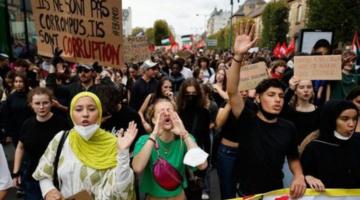 The 2026 French uprising is a continuation of the anti-colonial struggle, rooted in the 1961 Paris massacre of Algerians and the ongoing neocolonial relationship between France and its former…
 Disregard for Palestinian rights is a feature of Israeli politics rather than a bug. The upcoming Knesset election will change nothing for Palestinians, because every candidate across the political…
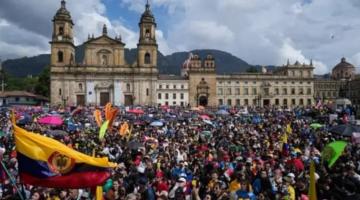 Thousands of people took to the streets across Colombia on Wednesday in the first national strike against President Abelardo de la Espriella’s administration, as police used tear gas, rubber bullets…
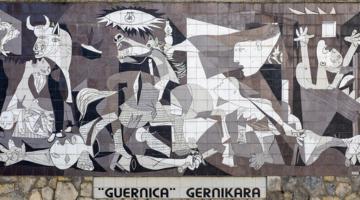 As we are experiencing a world order in disorder, with war and conflagrations and a shifting balance of power, Issa Shivji calls for a Sovereign Pan-African Project. The analyses recap the…
 In this week’s segment, we see through supposed disagreements between the US and Canada and recognize their partnership in settler colonialism, enslavement, and imperialism. But we begin with a…


