A Black Agenda Radio commentary by Glen Ford
The United States tries to finess its defeat in Iraq and approaching ejection from Afghanistan, clinging to its Asian lines as it expands the theaters of aggression to the south, to Yemen, Somalia, and the whole of Africa. "The aim is to corner Africa's oil and mineral resources, to draw new lines of empire to shut out China and even European allies."
A Black Agenda Radio commentary by Glen Ford
"No Iraqi government can long survive if it is not perceived as committed to kicking the Americans out."
The United States is losing or has already lost its two big land wars, in Afghanistan and Iraq. Over a million people have paid with their lives to teach the U.S. a 21st century lesson: that the most modern, expensive and lethal arsenal in the world cannot successfully occupy a country in which significant portions of the population are determined to resist. That's the same lesson the Vietnamese taught the Americans in the Sixties and early Seventies, at the cost of two to three million Vietnamese lives.
The United States will deploy every dirty trick and bribe in the book to remain in Iraq past the end of next year - the deadline extracted by the Iraqis from President Bush - and it is possible, although unlikely, that whatever Iraqi regime sits in Baghdad may give the Americans an extension of some kind. But no Iraqi government can long survive if it is not perceived as committed to kicking the Americans out. Aside from the 15 percent of the population that is Kurdish, there is no significant constituency for a U.S. presence in Iraq. Therefore, the Americans cannot stay. As an imperial power that has never in modern times voluntarily given up a military base in someone else's country, America's inevitable withdrawal from Iraq, even though in stages and kicking and screaming, represents a huge defeat.
Iraq was supposed to be the first stop in a rolling offensive that would have projected U.S. power deep into Asia, containing China and Russia and altering the global chessboard in America's favor for decades to come. Instead, the U.S. position in the world has further declined. President Obama drew a line at Afghanistan, embracing that war as his own. But the U.S. has failed spectacularly in constructing a viable client regime or even the semblance of an effective Afghan constituency for continued American occupation of the country. Moreover, every day the Americans remain in Afghanistan destabilizes neighboring Pakistan, the real birthplace of the Taliban, a nation where all but a small fraction of the population detests the United States, and a nuclear power. Therefore, the U.S. must someday soon cut its losses and leave. Obama may think he controls the Afghanistan timetable, but he doesn't.
"Somalia and the whole of the Horn of Africa are hot zones, under protracted U.S. assault."
As it is forced to face the prospect of retreat and defeat in its Asian land wars, the Obama regime shifts emphasis to special forces, drones and other devices of terror and assassination in an expanding theater of war to the south. Yemen, Somalia and the whole of the Horn of Africa are hot zones, under protracted U.S. assault. The U.S. Africa Command is active in almost every nation on the continent, methodically drawing African militaries into the U.S. orbit. The aim is to corner Africa's oil and mineral resources, to draw new lines of empire to shut out China and even European allies. Washington is determined to seize in Africa what is in the process of being lost to the empire in Asia. This is already the bloodiest chapter of all, with as many as six million lives lost in the Democratic Republic of Congo, alone, mainly due to the depredations of U.S. proxies Rwanda and Uganda. There is no way to avoid Africa being soaked in blood, as the U.S. attempts once again to change the global chessboard. That's what empires do, before they die.
For Black Agenda Radio, I'm Glen Ford. On the web, go to www.BlackAgendaReport.com.
BAR executive editor Glen Ford can be contacted at Glen.Ford@BlackAgendaReport.com.

 Aly Wane is on the advisory board of the Immigrant Justice Network. He joins us from Syracuse, New York to discuss the failure of the recent immigration bill and the bipartisan consensus on punitive…
 We're joined by Kevin Steele and Raven, two organizers of the Spirit of Mandela Coalition and About the People. We discuss their work and the "People's Senate Giveback & Genocide Convention…
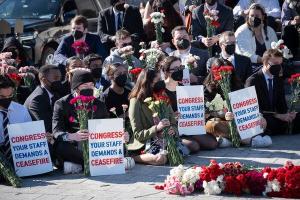 The nations that brag the most about "democracy" routinely ignore the will of their people. Support for Israel's war crimes in Gaza is but one example of this phenomenon.
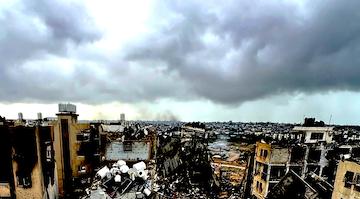 South African Pan-Africanist Victor Lungelo carefully maps the links between “Hitler’s Heirs:” Fascist South Africa and Zionist “Israel.”
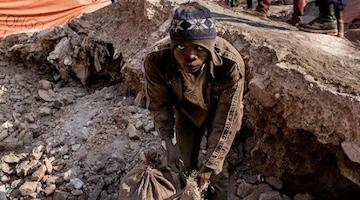 Ann Garrison speaks to Maurice Carney about the role of China in the Democratic Republic of the Congo’s mining industry.


