In this series, we ask acclaimed authors to answer five questions about their book. This week’s featured author is Dylan Rodriguez. Rodriguez is Professor in the Department of Media and Cultural Studies at the University of California, Riverside. His book is White Reconstruction: Domestic Warfare and the Logics of Genocide. The book was just awarded the Frantz Fanon Award for Outstanding Book in Caribbean Thought by the Caribbean Philosophical Association.
Roberto Sirvent: How can your book help BAR readers understand the current political and social climate?
Dylan Rodriguez: The term “white reconstruction” names the long half-century that has followed the official, legislated end of United States apartheid. My late, great friend, teacher, and colleague Clyde Woods (author of Development Arrested, among other things) encouraged me to develop this idea when he first heard me talk about it around 2010. I am especially interested in exploding the dominant national narratives of “post-civil rights” racial progress that vindicate cultural and political reforms as the solution for so-called social inequalities and disparities. Against these narratives, the book builds an analytical framework that conceptualizes the historical logic of reform as a strategy of counterinsurgency against Black radical, abolitionist, anti-colonial, and other forms of revolutionary and irruptive threat to what I call (drawing heavily from Sylvia Wynter and Frantz Fanon, among others) the “ascendancy of White Being.”
White reconstruction neither began nor culminated in the electoral events of November 2016 (or for that matter, November 2008). Rather, it is a persistent feature of U.S. and hemispheric counterinsurgent warfare against the radically disruptive, if not revolutionary implications of self-determining Black life, Indigenous futurity and radical sovereignty, anti-colonial and decolonizing confrontations with neoliberal racial capitalism, and so on.
What do you hope activists and community organizers will take away from reading your book?
That reformism is a primary political and cultural vehicle of contemporary counterinsurgency against abolitionist, Black radical, anti-colonial/decolonizing and other forms of collective movement and liberated life. Reformism takes shape through a flexible, changing ensemble of institutions, cultural forms, aesthetics, and political rituals that often steal the language, energy, and ideas of activists and community organizers to domesticate, commodify, and absorb them (and their communities) into processes that undermine the capacity to fundamentally change relations of domination and power. I know that’s a lot, but I’ll just repeat what I mention in the book’s introduction: that Robert Allen was prophetic when he analyzed the genesis of the nonprofit industrial complex in real time, in his classic book Black Awakening in Capitalist America (1969). Fifty-plus years later, U.S. based activists and community organizers—and for that matter academics—cannot easily work independent of the financial and political influence of the NPIC and its conglomeration of philanthropists, foundations, corporate influence, and deep connections to the state. This is a present tense expression of the historical logic of white reconstruction.
We know readers will learn a lot from your book, but what do you hope readers will un-learn? In other words, is there a particular ideology you’re hoping to dismantle?
The narratives, propositions, seductions, and ongoing grift of liberalism and progressivism are the front lines of domestic counterinsurgency in the United States and elsewhere. Every single one of us who cares about the liberation of Black, Indigenous, and colonized people, among others targeted by ongoing Civilizational warfare in all its forms, must accept the responsibility of un-learning our attachments to this counterinsurgency.
Who are the intellectual heroes that inspire your work?
I have already mentioned a few: Wynter, Fanon, Woods, and Allen. There are, of course, way too many more to name here, but I will say that I am constantly inspired by the streams of revolutionary, speculative, abolitionist, and unapologetically wild and militant thought that flow from people who are engaged in some form of collective study—whether in the form of movement organizations, study groups, artist communities, community based emergency and mutual aid collectives, or incarcerated people’s political education infrastructures, among others. I feel like Safiyah Bukhari, Haunani-Kay Trask, Cedric Robinson, and about a thousand other people are right here with me all the time.
In what way does your book help us imagine new worlds?
I write from the admittedly self-implicating premise that the most effective forms of insurgent creativity call on scholars, teachers, artists, students, and other thinkers/makers to weaponize themselves (and not merely their “work”) in the service of an ongoing counter-Civilization guerilla/fugitive war that assumes various forms among different peoples, sometimes in friction and antagonism with each other because it is often a wild fucking mess. I hope that readers will understand that this book is not exclusively concerned with developing a useful analytical and theoretical toolset for understanding the contemporary moment of domestic counterinsurgency. It is animated, from beginning to end, by a deep affinity with peoples and movements that exhibit the will and/or capacity to expel or overthrow Civilizational power at any scale, from prison cell to occupied neighborhood. In this sense, White Reconstruction is in direct and indirect dialogue with collectives, communities, organizations, young people, peers and elders involved in struggles to create thriving life, joy, beauty, autonomy, sustainable health and shared knowledge under conditions of duress. The book honors the alter-worldly substance of liberated being that is constantly exemplified by different insurgent peoples—that is, those with whom I am declaring affinity or, perhaps, a grounded political love.
Roberto Sirvent is editor of the Black Agenda Report Book Forum.

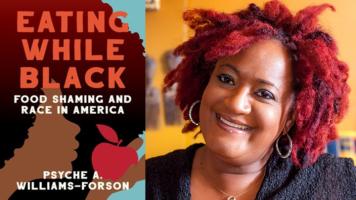 This week’s featured author is Psyche A. Williams-Forson. Williams-Forson is Professor and Chair of American Studies at the University of Maryland, College Park. Her book is Eating While Black: Food…
 The recent Supreme Court decision which banned the use of race as a criterion for college admissions is indeed racist. The decision also obscures the need for Black unity and for a new Black…
 The 4th of July celebration is a relic of American exceptionalist ideology. There is very little independence in a capitalist dictatorship.
 Days of extreme heat without access to enough water and cooled air become deadlier for an aging prison population.
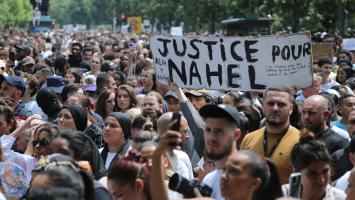 Protests erupted in France after police killed a teenager of Algerian and Moroccan ancestry. Just as in the U.S. racism in France is the cause of police violence.


