"My own university, Vanderbilt, joined in on the attack."
As we celebrate the 200th anniversary of Lincoln's birth, the 100th anniversary of the founding of the National Association for the Advancement of Colored People, the inauguration of America's first black president, and Black History Month, it's worth pondering the question, "Who won the Civil War?"
On November 20, 2002, I wrote in a Nashville newspaper that a relatively new, taxpayer-funded, gun-toting statue honoring the founder of the Ku Klux Klan should be removed. This founder had executed black soldiers, along with women and children, instead of taking them prisoner - the penalty for inciting slave insurrection, under Confederate law, being death - and, under today's laws, he would be given Eichmann's sentence, not a statue.
Immediately came death threats. "Get a bodyguard or carry [a] gun," wrote Christopher Barwick, adding: "you will need it."
"Forget Iraq," wrote Jay and Pam Simms: "we should call in an air strike on [Farley's university] department."
Henry Maston said, "I hope someone kills and rapes your white, race-traitor wife and/or girlfriend as well."
Gordon Baum, head of the national Council of Conservative Citizens - the "uptown Klan," according The Nation Magazine's John Nichols - attacked me on National Public Radio; in an unsigned editorial, the Council wrote, "Vanderbilt professor Johnathan Farley (sic) was educated at Harvard and Oxford, but his simple-minded tirades ... indicate how low prestigious universities will stoop to dole out fancy degrees to blacks ... Let's gather a mob."
Instead of defending me against such vitriol or remaining silent, my own university, Vanderbilt, joined in on the attack. Both the head of Vanderbilt, Gordon Gee, and the university spokesman, Michael Schoenfeld, criticized me, the former calling me "volatile" and the latter an extremist. At no point did either of these men utter one word of criticism about the founder of the KKK, the Confederacy, or any of the individuals or groups targeting me for defamation, termination, hospitalization, or worse.
"The NAACP Legal Defense Fund was also informed, but took no action."
As a Life Member, I went to the NAACP for help. The Nashville chapter president, Ludye Wallace, agreed to write a letter of support, but the very next day backed away, saying he did not want to be "out there" like me. His successor as president, Sonnye Dixon, refused to ask the local newspaper to stop publishing libel against me, even though the articles could lead to death threats being issued against anyone described as a supporter of mine - as happened to Vanderbilt Black Student Alliance president Nia Toomer.
Even Gordon Gee had to call police for protection after a man threatened to "cut [his] heart out." One of Dixon's successors as Nashville NAACP president, Arnett Bodenhamer, and the latter's assistant, Tommie Morton-Young, would also do nothing.
The head of the NAACP in the Southeast United States, Charles White, was informed of the situation when it first erupted, but said the NAACP could only consider the issue in three months. The NAACP Legal Defense Fund was also informed, via the wife of Ben Jealous, current national president of the NAACP, but took no action. Meanwhile, my essay criticizing the Klan founder was being branded a "hate crime" by national columnists like Walter Williams and Paul Craig Roberts, Assistant Secretary of the Treasury under Ronald Reagan. The attack continued in the Washington Times and on Fox News with Brit Hume.
"The United Daughters of the Confederacy targeted me with extreme prejudice."
Eventually, I wrote Julian Bond, chairman of the national NAACP. Bond replied that he himself would not have asked for or expected any help from the NAACP: it was my own "responsibility" to deal with the attacks. When I told this to Ben Jealous at a family Thanksgiving, he replied that Bond probably figured it was my own fault - that I had asked for it, that I had had it coming.
While the NAACP showed no interest in my case, the United Daughters of the Confederacy, a 25,000-member organization that commemorated the last ride of the KKK in Nashville, targeted me with extreme prejudice. They even sought to take legal action against me for having written the essay. Eventually I fled the state, leaving many of my belongings behind.
Pouring salt in the wound, the Nashville NAACP gave an award to Gordon Gee - the man who, by criticizing my critique of the founder of the KKK, was indirectly defending him. Indeed, Gee called the Daughters of the Confederacy "old friends."
I told Vanderbilt I wanted to take an unpaid leave of absence to avoid more death threats. Vanderbilt Dean Richard McCarty wrote that "a purported debate over whether the founder of the Ku Klux Klan should be honored in Nashville, and past threats you claim have been made against you," were not good enough reasons, and that if I did not return to Vanderbilt he would have me fired. Weeks after McCarty wrote this, a Nashville judge issued a $700,000.00 judgment in favor of the UDC and against Vanderbilt, unless Vanderbilt surrendered. Vanderbilt surrendered.
America has indeed come a long way. Perhaps, by the end of this century, a black man will finally be able answer the question, without taking his life into his hands:
Who won the Civil War?
Dr. Jonathan David Farley was a Martin Luther King Visiting Associate Professor of Applied Mathematics at MIT in 2003 and 2004. He can be contacted lattice.theory@gmail.com

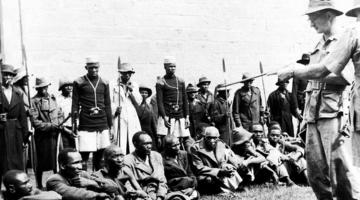 The British sought to cover up their atrocities in Africa and the Caribbean by manipulating information to obfuscate history.
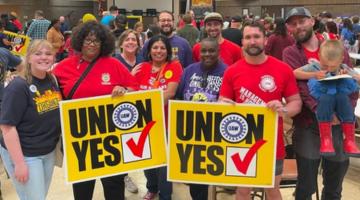 The vote by Volkswagon workers in Tenessee to unionize with the United Auto Workers union is a clear indication that it is possible to organize in the South.
 The destruction of the environment and acceleration of the climate crisis happen silently under the veil of “national security,” despite the fact that the environmental toll of war is the most…
 This week we discuss the proliferation of lies about non-citizen voting and U.S. policy toward Niger. First, we talk to Danny Haiphong about U.S. policy toward China and what we can learn from…
 We are joined by Danny Haiphong to discuss the current delegation to China that Margaret Kimberley has joined, U.S./China relations, and the importance of studying Chinese socialism.


