 by BAR executive editor Glen Ford
The world’s sole superpower behaves as if Haitian sovereignty no longer exists. Notions of legality are wholly absent in America’s occupation of Haiti, where the U.S. poses as the internationally recognized authority. Washington arrogantly improvises the terms of the Haitian “protectorate.”
U.S. Attempts to Erase Haitian Nationhood
by BAR executive editor Glen Ford
“The Haitian people ‘need democracy and self determination, said the U.S.-based Black is Back Coalition.”
Proud Haiti has been reduced to a de facto “protectorate” of the United States – a grotesque form of non-sovereignty in which the subjugated nation is “protected” by its worst enemy. Namibia under white-ruled South African administration comes to mind, although in Haiti’s case the United Nations does not even pretend to be on the side of the oppressed, acting instead as agent and enforcer for the superpower.
As Haiti writhes under the agony of hundreds of thousands dead, Bill Clinton picks through the bones in search of prime tourist spots and mango plantation sites. America’s most successful snake oil salesman is pleased to do the Haitian people’s thinking, planning and dreaming for them – and quite willing to speak for the afflicted country, as well. “This is an opportunity to reimagine the future for the Haitian people, to build what they want to become, not rebuild what they used to be,'' Clinton told the global oligarchs at the World Economic Forum in Davos, Switzerland.
In one sweeping sentence, Clinton claimed a kind of sovereignty over the Haitian people’s very imaginations, assigning himself the right to filter what was good or bad about Haiti’s past, and what is permissible in the future. Haitians are no longer allowed to possess their own dreams and remembrances, which have apparently been placed in United Nations trusteeship, under control of UN special envoy to Haiti, Bill Clinton.
“MINUSTAH and the U.S. expeditionary force have conspired to starve out what’s left of Cite Soleil.”
As one of the world’s most shameless personalities, the former president is eminently qualified to represent both the UN and the U.S. armed missions in Haiti. The 9,000 troops and police of the UN Stabilization Force in Haiti (MINUSTAH) have for years waged war on the seaside shanty neighborhood of Cite Soleil, a political stronghold of exiled president Jean-Bertrand Aristide. Before the February, 2004, U.S.-backed coup, Cite Soleil was home to at least 300,000 desperately poor but politically organized people. Relentless MINUSTAH raids have drastically shrunk the slum’s population. By 2006, only 30 percent of residents still remained in some sections of Cite Soleil, according to human rights workers.
Since the earthquake, MINUSTAH and the U.S. expeditionary force have conspired to starve out what’s left of Cite Soleil. Three weeks after the catastrophe, the United Nations World Food Program described Cite Soleil as “no-go, for security reasons.”
Have the people of Cite Soleil been condemned to death and dispersal because of their pro-Aristide politics – a trait they shared with at least 60 percent of the population the last time a count was permitted – or are they doomed by their choice seaside location? Either reason will do, or both. Haiti’s poor are condemned in advance, for existing where inconvenient.
“Small rice farmers were forced off the land and into the shanty-opolis.”
The Haitian peasantry, which not so long ago kept the country self-sufficient in basic foodstuffs, became inconvenient after Washington forced Haiti to accept U.S. government-subsidized rice. Port-au-Prince, a town of about a quarter million in 1960, swelled to at least 2.5 million as small rice farmers were forced off the land and into the shanty-opolis, where they built what they could with the resources at hand. U.S.-imposed “structural adjustment” made Port-au-Prince a high-density death trap.
Somehow, this U.S.-mandated migration – which also contributed to the exodus abroad of many hundreds of thousands – is now numbered among the many “failures” of the Haitian people. They must now move again, to places outside Port-au-Prince where they can “reimagine the future,” in Bill Clinton’s words. But whatever the Haitians might imagine, the United States is determined to deny them the right to pursue those dreams. Americans hector Haitians to summon the will to rebuild, but strangle Haitian civil society by effectively outlawing the nation’s most popular political party, Aristide’s Fanmi Lavalas. Self-determination is among those things Haitians must not be permitted to rebuild or reclaim.
“The U.S. strangles Haitian civil society by effectively outlawing the nation’s most popular political party.”
The Americans seem to prefer that Haitians have no government, at all, even one as compliant as that of President Rene Preval, who collaborated in banning Fanmi Lavalas from taking part in elections. Only one cent of every dollar in U.S. “relief” money goes to or through the Haitian government, which is thus reduced to a crippled and largely irrelevant spectator. The Americans will at some point “reimagine” precisely how the Haitian “protectorate” will be managed in these extraordinary times.
The Haitian people “need democracy and self determination,” said a statement by the U.S.-based Black is Back Coalition for Social Justice, Peace and Reparations, “not more military interventions by the U.S., which has sent more than 10,000 troops to subdue our people.” On February 20, the Black is Back Coalition will hold a National March and Rally to Defend Haiti, in Miami, Florida. “Our people in Haiti must have reparations, not self serving charity from France and the U.S.”
BAR executive editor Glen Ford can be contacted at Glen.Ford@BlackAgendaReport.com.

 The government of Mali has accused France of numerous violations of its airspace and has requested that the United Nations Security Council investigate. French forces may have left Mali, but the…
 This article was written on the occasion of the sixth summit between the European Union and the African Union which was held in Brussels on 17 and 18 of February 2022. These meetings are…
 The history and significance of Black August, presidential elections and politics in Kenya, and reflections on the anniversary of the Sandinista Revolution.
 Kalonji Changa is co-founder of Black Power Media and founder of FTP Movement. He joins us from Atlanta to talk about Black August, which has been a fixture of the liberation movement for 43 years.
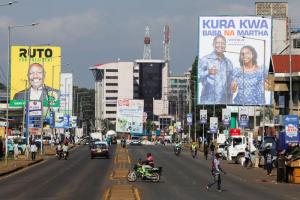 Irene Asuwa joins us from Nairobi, Kenya. She is co-convener of Ecological Justice and supports outreach at Ukombozi Library. We discuss the recent presidential election in that country.


