Say No to Africom
by Danny Glover and
Nicole C. Lee
This article originally appeared in The Nation.
"Africom is a dangerous
continuation of US military expansion around the globe."
With little scrutiny from Democrats in Congress and nary a
whimper of protest from the liberal establishment, the United States will soon
establish permanent military bases in sub-Saharan Africa. An alarming step
forward in the militarization of the African continent, the US Africa Command
(Africom) will oversee all US military and security interests throughout the
region, excluding Egypt. Africom is set to launch by September 2008 and the
Senate recently confirmed Gen. William "Kip" Ward as its first
commander.
General Ward told the Senate Armed Services Committee that
Africom would first seek "African solutions to African problems." His
testimony made Africom sound like a magnanimous effort for the good of the
African people. In truth Africom is a dangerous continuation of US military
expansion around the globe. Such foreign-policy priorities, as well as the use
of weapons of war to combat terrorist threats on the African continent, will
not achieve national security. Africom will only inflame threats against the
United States, make Africa even more dependent on external powers and delay
responsible African solutions to continental security issues.
The US militarization of Africa is further rationalized by
George W. Bush's claims that Africom "will enhance our efforts to bring
peace and security to the people of Africa" and promote the "goals of
development, health, education, democracy and economic growth." Yet the
Bush Administration fails to mention that securing and controlling African
wealth and natural resources is key to US trade interests, which face growing
competition from China. Transnational corporations rely on Africa for
petroleum, uranium and diamonds - to name some of the continent's bounty. West
Africa currently provides 15 percent of crude oil imports to the United States,
and that figure is expected to rise to 25 percent by 2015.
"Securing and controlling African wealth and natural
resources is key to US trade interests."
Policy-makers seem to have forgotten the legacy of US
intervention in Africa. During the cold war, African nations were used as pawns
in postcolonial proxy wars, an experience that had a devastating impact on
African democracy, peace and development. In the past Washington has aided
reactionary African factions that have carried out atrocities against
civilians. An increased US military presence in Africa will likely follow this
pattern of extracting resources while aiding factions in some of their
bloodiest conflicts, thus further destabilizing the region.

Misguided unilateral US military policy to "bring peace
and security to the people of Africa" has, in fact, led to inflamed local
conflicts, destabilization of entire regions, billions of wasted dollars and
the unnecessary deaths of US soldiers. The US bombing of Somalia in January -
an attempt to eradicate alleged Islamic extremists in the Horn of Africa -
resulted in the mass killing of civilians and the forced exodus of refugees
into neighboring nations. What evidence suggests Africom will be an exception?
In contrast, Africa has demonstrated the capacity to
stabilize volatile situations on its own. For example, in 1990 the Economic
Community of West African States set up an armed Monitoring Group (Ecomog) in
response to the civil war in Liberia. At their height, Ecomog forces in Liberia
numbered 12,000, and it was these forces - not US or UN troops - that kept
Liberia from disintegrating. In another mission, Ecomog forces were
instrumental in repelling rebels from Sierra Leone's capital, Freetown.
"Policy toward Africa must be rooted in the principles of
African self-determination and sovereignty."
There are a range of initiatives that can be taken by the US
government and civil society to provide development and security assistance to
Africa that do not include a US military presence. Foremost, policy toward
Africa must be rooted in the principles of African self-determination and
sovereignty. The legitimate and urgent development and security concerns of
African countries cannot be fixed by dependence on the United States or any
other foreign power. Instead of military strategies, African countries need
immediate debt cancellation, fair trade policies and increased development
assistance that respects indigenous approaches to building sustainable
communities. Civil wars, genocide and terrorist threats can and must be
confronted by a well-equipped African Union military command.
American policy-makers should be mindful that South Africa,
whose citizens overthrew the US-supported apartheid regime, opposes Africom. In
addition, Nigeria and the fourteen-nation Southern African Development
Community resist Africom. These forces should be joined by other African
governments and citizens around the world, to develop Africa's own strong,
effective and timely security capacities. Progressive US-Africa policy
organizations and related civil society groups have not been sufficiently
organized to bring this critical issue before the people of the United States.
It is urgent that we persuade progressive US legislators to stop the
militarization of aid to Africa and to help ensure Africa's rise to responsible
self-determination.
Danny Glover and Nicole C. Lee are,
respectively, chairperson and executive director of TransAfrica Forum.

 Black graduate students at the Massachusetts Institute of Technology wrote this statement in support of Palestinians and of their rights to speak and act freely.
 Panamanians are in protest against a contract granted to a Canadian Mining Company. Black communities are particularly impacted by environmental degradation and displacement caused by open-pit mining.
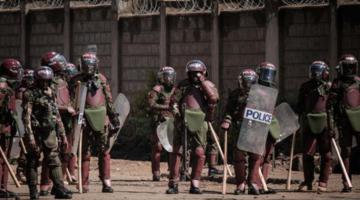 The Kenyan government now demands that the United Nations pay for the deployment of a police force to Haiti. But Black face imperialism is the problem, not negotiations over money.
 Workers around the world can play a role in mobilizing action against the apartheid Israeli state.
 In this series, we ask acclaimed authors to answer five questions about their book. This week’s featured author is J. Brent Crosson. Crosson is Associate Professor of Religious Studies and…


