MLK Day Wal-Mart Action
MLK Day Call to Action Against Wal-Mart
by the editors
“Wal-Mart is engaging in an opportunistic strategy that takes advantage of people of color, primarily.”
“Wal-Mart has become our lunch counter moment for the 21st Century,” declared Rev. Lennox Yearwood, head of the Hip Hop Caucus and one of 100 Black civil rights, religious and business leaders to issue a “Call to Action” against the retail giant Wal-Mart on Dr. Martin Luther King, Jr.’s birthday, January 15. “The same way that those students” from North Carolina AT&T were denied “their racial rights” to be served at a lunch counter in 1960, “we are now being denied our opportunity. It’s time for an Opportunity Rights Movement.”
“This lack of real opportunity for advancement has created a feeling of hopelessness” among too many Black youth.
Yearwood was among ten leaders who spoke at a press conference organized by the Los Angeles Alliance for a New Economy (LAANE), a driving force in the successful struggle to deny Wal-Mart a planned “superstore” in predominantly Black and Latino Ingleside, California, in 2004.
The youthful Black preacher deplored Wal-Mart’s “slashing the number of full-time jobs and imposing wage caps” on its workforce – numbering 1.3 million in the U.S., 1.4 million worldwide, larger than that of GM, Ford, GE, and IBM combined. “This must change,” said Yearwood. “Our message to Wal-Mart is clear: Our communities deserve good jobs. This is the only way that we can provide a future for our children.” Dr. Martin Luther King was killed “fighting for good jobs. We will let Wal-Mart know that the dream did not die on the balcony, and it will definitely not die in Wal-Mart.”
In a written statement to Wal-Mart CEO Lee Scott, the 100 Black leaders demanded
“that Wal-Mart offer good jobs that provide quality health insurance and living wages, and that allow employees to work free from discrimination and intimidation. The nation’s largest employer should not force its employees to rely on charity and government assistance.
“that Wal-Mart respect the proud democratic tradition of our country instead of trying to undermine the decisions of elected representatives with lawsuits, phony citizen initiatives, and slick public relations campaigns.”
The same 100 leaders issued an open letter to Black elected officials, urging them to resist Wal-Mart’s “spin campaign” and “embrace a vision for our communities rooted in the American ideal that hard work deserves to be rewarded.”
“Our message to Wal-Mart is clear: Our communities deserve good jobs.”
Such sentiments fly in the face of Wal-Mart’s well-known business model: to relentlessly drive down the costs of labor and prices paid to vendors, in order to maximize profits.
Rev. Eric Lee, Executive Director of the Southern Christian Leadership Conference of Greater Los Angeles, sees continuity in Dr. King’s struggle and the “Call to Action” on his birthday.
“Almost 40 years ago, Dr. Martin Luther King Jr. was speaking on behalf of African American sanitation workers who were receiving low wages and poor working conditions, and had restricted access to affordable benefits. He was subsequently assassinated, April 4, 1968.
“Here we are in 2007. Wal-Mart has essentially identified a market in which there is high unemployment, coupled with the need for low cost retail products, and is effectively and aggressively taking advantage of the situation. Wal-Mart is engaging in an opportunistic strategy that takes advantage of people of color, primarily, needing and wanting employment – therefore, accepting this low wage positions, poor working conditions, and unaffordable access to benefits.
The second part of the Wal-Mart strategy, said Rev. Lee, is to undercut small business by providing lower priced products. “It is a corporate strategy that devalues the residents and businesses in inner city minority communities.”
Even given the dearth of employment in inner cities, Wal-Mart’s deal for workers and communities is “simply unacceptable,” said California State Senator Gilbert Cedillo, of Los Angeles.
Wal-Mart was born in the near-lily-white Ozarks region. Now, having “saturated rural and suburban markets,” said Tracy Gray-Barkan, Director of Retail Policy and Senior Research Analyst LAANE, “the retail giant is looking to penetrate urban areas, particularly communities of color.” Ms. Gray-Barkan is author of a report on Wal-Mart’s strategy and ways to resist it: “Wal-Mart and Beyond: The Battle for Good Jobs and Strong Communities in America.”
“The bad business practices of Wal-Mart turn its very size into a bigger and bigger weight around the necks of poor people.”
Wal-Mart’s multi-million dollar PR campaign is designed to create a “new fiction about its impact in our communities,” said Van Jones, Executive Director of Oakland’s Ella Baker Center for Human Rights. “Those efforts would be better spent in creating new facts for our communities…like living wages at union jobs with decent benefits.”
“America cannot afford for our biggest retailer to continue to act as a financial giant and a moral midget…. The bad business practices of Wal-Mart turn its very size into a bigger and bigger weight around the necks of poor people,” Jones concluded.
Former Atlanta Mayor, congressman and UN Ambassador Andrew Young, once a top aide to Dr. King, recently resigned as chief Black flack for Wal-Mart, after making what some considered to be racist comments about Jewish and Arab merchants. Responding to a question from the press, Georgia Stand-Up Executive Director Deborah Scott said: “People were very outraged that [Young] would take the contract” in the first place, but were “very pleased when he was fired…. People saw behind the spokesperson.”
To comment on or discuss this article in the Black Agenda Blog, click here

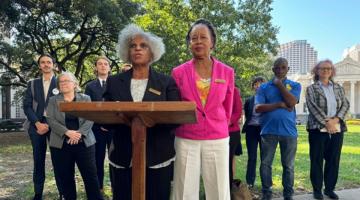 In St. James Parish, a zoning ordinance divides industrial development along racial lines.
 Yahya Sinwar was a man who became a larger-than-life symbol of Palestinian resistance and struggle. Myths and rumors surrounded him in life and now in death but he did not need anyone, friend or foe…
 As part of this research on grassroots economic projects toward Black Liberation, Austin Cole spoke with Nicholas Richard-Thompson about his community organizing, expanding definitions of…
 Community leaders sign statement backing candidates supporting Gaza ceasefire and arms embargo against Israel.
 Activists organizing against the militarized police training facility in Atlanta are facing new forms of repression.


