by Benjamin Woods
African American mythology tells us that the Black Freedom Movement was born in the church. That’s because “the Black church has had better propagandists than Black freethinkers.” But freethinkers also populate the liberation pantheon, while the church has sometimes proven an obstacle to the Movement.
Black Secularists and The Church
by Benjamin Woods
Goodbye,
Christ Jesus Lord God Jehovah,
Beat it on away from here now.
- Langston Hughes “Goodbye Christ”
“Contrary to popular opinion, atheism is not a Eurocentric or ‘white thing.’”
Every year, the Pew Research Center publishes a survey which consistently demonstrates that Black people are the most religious group in the United States. This is not surprising considering that the Black Liberation Movement has been influenced by spirituality, particularly Christianity. The historical and contemporary religiosity of Blacks leads many to incorrectly assume spiritually/religion has been at the center of the Black Movement. History tells a different story.
In every stage of the Black movement you can find atheists, agnostics, skeptics or people better known as freethinkers. For example, while a Southern missionary in the 1830s, AME minister Daniel Payne stated enslaved Africans “scoff at religion itself…Yes, I have known them to even question [God’s] existence.”
Today, young Black people question a God who would allow the persistent violence in their communities or huge disparities in wealth between poor Black and affluent white communities. Therefore, contrary to popular opinion, atheism is not a Eurocentric or “white thing” but is an indigenous intellectual development that organically emerges out of the Black experience. Lastly, this challenges the common held assumption that faith in God was necessary to survive the horrors of slavery, sharecropping, and segregation.
Several Black political leaders and intellectuals have been critical of the Black church, some have completely rejected faith. An example is Black atheist WEB Dubois. Dubois is known as the first African to attain a PhD from Harvard and arguably the most revered Black intellectual of the 20th century. He boldly asserted, “I do not believe in the existence and rulership of the one God of the Jews” and “Death is the end of Life.”
“The historical and contemporary religiosity of Blacks leads many to incorrectly assume spiritually/religion has been at the center of the Black Movement.”
Dubois praised the Soviet Union for removing religion from public education. In his eyes the Black church defended the oppression and exploitation of Blacks and a lack of free thinking. Although Dubois is one of the most read Black thinkers in history, his atheist views have been overlooked. Other Black leaders who were also freethinkers include A. Philip Randolph, Langston Hughes, and Howard University’s own Zora Neale Hurston to name a few.
To an extent, the Black church has had better propagandists than Black freethinkers. Most know of the contributions of the church to the Civil Rights Movement but what about the obstacles it has posed? For instance, at the 1961 National Baptist Convention, the largest Black religious group in the US, progressive ministers such as M.L.K. attempted to have the organization support civil rights. The idea of supporting Black human rights was so controversial, that a physical fight ensued and one minister was killed at the convention! Lord have Mercy, chile!
In conclusion, although everyone is entitled to their own personal belief or lack thereof, the Black movement should be secular. Whether it is the independence movements in Africa such as FRELIMO (Mozambique), MPLA (Angola), or the Black Panther Party in the US, spirituality was, at best, a secondary factor. As a Black skeptic examining this information, I ask “Do we need spirituality or religion in order to build and sustain a mass movement?” I doubt it.
Benjamin Woods is a PhD Candidate at Howard University, and an organizer of Students Against Mass Incarceration (S.A.M.I.). He can be contacted at samiathu@gmail.com.

 Cedric Robinson's Black Marxism can be used as a tool to further expand our understanding of Israel's settler colonial domination over Palestine.
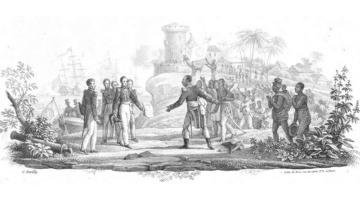 Black scholars have worked to challenge the accepted white supremacist imperialist historical narrative of colonialism and enslavement. The legacy of the Haitian Revolution sits at the center of this…
 The United States once again failed in its attempt to force regime change in Venezuela and extinguish the growth of socialism in South America. Therefore, it reverted to its old and unsuccessful…
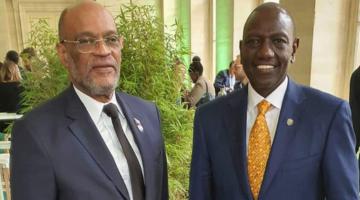 Kenya’s police deployment to Haiti and the spurious claim of "reciprocity", knowingly and willfully promoted by Ariel Henry, William Ruto, and others, is in flagrant violation of the National Police…
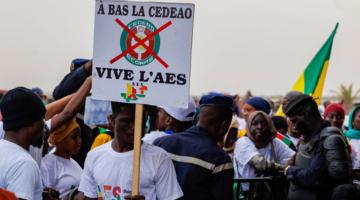 Mali, Burkina Faso, and Niger pulled out of the West African economic union ECOWAS, in major blow to the regional integration project and rejection of Emmanuel Macron’s efforts to…


