by Pascal Robert
Photos by Kevin Banatte[Dream Defenders Communications
Relentless forces, internal and external, seek to pit Black Americans and immigrants against one another. However, many immigrants are Black and subject to the same mass incarceration policies as African Americans. “Immigration is a racial justice issue that needs a progressive African American voice,” according to a just-concluded conference in Miami.
Black Like Me: Black Immigration Conference in Miami
by Pascal Robert
“The broader policy initiatives that are economically hurting Blacks in the United States and the immigrant community in their respective countries stem from the same problems caused by global capitalism.”
From May 23 to May 25, 2014 in the Little Haiti district of Miami, Florida a conference attended by over 150 activists and community leaders from around the country came together to discuss immigration as a racial justice issue. Rarely is immigration in corporate media depicted as an issue of concern to Black Americans. Cynical anti-immigrant forces sometimes try to use the issue as a wedge to cause division between communities of color who all share the common enemies of racism and economic exploitation. However, the Black Immigration Network, a consortium of racial justice activists, community leaders, and immigrant’s rights activists realizes that the similarity between the plight of Black Americans and the immigrant community on core issues such as mass incarceration, immigrant detention, globalization, and reactionary racism require a combined effort in the age of neoliberal capitalism.
The Black Immigration Network’s Kinship Assembly in Miami was spearheaded by the Black Alliance for Just Immigration, (BAJI) a Brooklyn, New York based organization founded in 2006 by community leaders who realized that immigration is a racial justice issue that needed a progressive African American voice. In speaking with the Co-Director of BAJI, Gerald Lenoir, the importance of understanding immigration from a racial justice perspective became clear. Lenoir explained that contrary to the notion that immigrants are simply coming to the United States seeking the American dream, a better analysis shows how American policies around globalization destabilize the economic opportunities for immigrants in their respective countries through tactics such as destroying domestic agricultural production in those countries. Lenoir emphasises that the same way the African American community lost jobs after the 60s Black Power era because of urban de-industrialization fostered by globalization and free trade agreements, the various poor countries where immigrants migrate from had their respective economies ravaged by those same policies. Therefore, BAJI understands the broader policy initiatives that are economically hurting Blacks in the United States and the immigrant community in their respective countries stem from the same problems caused by global capitalism.
“American policies around globalization destabilize the economic opportunities for immigrants in their respective countries.”
BAJI also focuses on one of the most vexing issues facing Black America and ties it into the need for immigration justice: mass incarceration and immigrant detention. A subject that received great attention at the Black Immigration Network’s Kinship Assembly was how mass incarceration, the private prison industry, immigrant deportation, and racial profiling all stem from the same racist obsession with locking up Black and brown bodies. The conference highlighted that Black Caribbean and African Immigrants were represented among immigrant detainees five times their number in the overall undocumented community. As Gerald Lenoir explained, Black immigrants are being racially profiled to be locked up in immigrant detention the same way African Americans are being racially profiled for mass incarceration. Lenoir explained how federal policies such as using Immigrations and Customs Enforcement Holds (I.C.E. HOLDS) and “Secure Communities,” programs ramped up in the Obama age have caused the detention and deportation of over two million undocumented immigrants. Such numbers are unprecedented causing Obama to be deemed by immigrants rights activists as the “detainer and chief.”
When speaking to Terrence Courtney, the Southeast Regional Organizer for BAJI he stated, “The Connection between mass incarceration, immigrant detention and deportation is important because it connects the life experiences of Black people in America to those particularly in the Black immigrant community since they are overwhelming targets of such detention.” Courtney further stated, “Incarceration and immigrant detention are a means of social control in neoliberal capitalism because they force people into limited options of low wage labor and social stigmatization.”
Courtney especially highlighted the issue of Black female incarceration, detention, and deportation. He shared, “Often when discussing mass incarceration and immigrant detention the discourse is framed in a male gendered fashion. In reality, the fastest rate of incarceration in America today is among Black women and this also provides opportunity to justify cuts in social services these women tend to greatly depend on.” Courtney continued, “Black American and Black Immigrant women are disproportionately affected by neoliberal privatization of government services whether they be public hospitals being privatized, municipal transportation, or corporate charter schools due to their roles as caretakers of children.”
The similar economic plight of Black Immigrants and Black Americans is something Courtney further emphasised. He stated, “Black foreign born workers have the highest rates of unemployment and the lowest wages of any foreign born racial groups the same way Black Americans have the highest rates of unemployment and lowest wages of any U.S. citizens.”
In discussing the prospects of comprehensive immigration reform Lenoir stated that the last proposal which came out of the U.S. Senate was horrible. The proposals did not view immigration justice as a family based issue but a merit based issue. Moreover, the focus on reducing immigrants to temporary workers who could be recycled back in and out of the country violated the spirit of true immigration reform.
“Black immigrants are being racially profiled to be locked up in immigrant detention the same way African Americans are being racially profiled for mass incarceration.”
Gerald Lenoir also discussed the importance of Haiti as model for America’s unjust treatment of immigrants and pernicious economic policy as key concern of the Black Immigration Network. Reuniting Families is a sponsored program that tries to connect Haitians with visas who are stuck in the immigration backlog with their family members. Lenoir explains that Haiti represents the best example of how race and immigration issues come together to oppress the Black undocumented community.
In line with bringing together issues concerning African Americans with the immigrant community, the Black Immigration Network Kinship Assembly also held panels lead by the Dream Defenders on taking over the Florida Capitol to fight “Stand Your Ground” laws, A “Free Marissa Alexander” forum held by the Black Women Cultural Alliance as well as an African Diaspora Dialog. The conference was attended by Black American, Haitian, Afro-Caribbean, African, and Latino activists and leaders all working toward racial and immigration justice.
The Black Immigration Network Kinship Assembly represented the best traditions of community activism around important issues of racial justice and immigrant rights. For such a young organization, the synergy and vision of these activists provides a glimmer of hope in a period where movement activism is truly needed to address the status quo agenda.

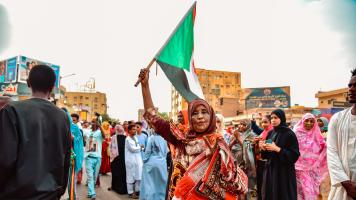 In the aftermath of the violent repression of protesters on June 30, sit-ins have been organized in various parts of Sudan even as the military junta tries to consolidate power.
 The U.S. is empire is in a state of crisis, creating chaos around the world and contradicting its own goals.
 Liberation struggles are not fought only on the battlefield. The African Party for the Independence of Guinea-Bissau and Cape Verde (PAIGC) left a legacy of educational decolonization.
 Congresswoman Karen Bass is running for mayor of Los Angeles. She's also Vice Chair of the NED, the CIA's soft power arm. She epitomizes everythng that is wrong with the Black political class.
 The 55th anniversary of the Newark, New Jersey rebellion, how the child welfare system damages Black children and families, and how the United Nations creates suffering in Haiti.


