 by Aaron Tesfaye
The first victims of the change in global precipitation patterns will not be people from rich, polluting nations who engage in ruinous consumption, but the poorest of the poor – such as African pastoralists who exist ‘precariously at the periphery’, Aaron Tesfaye writes in Pambazuka News. As world leaders prepare for the UN Climate Change Conference in December, Tesfaye looks at why the summit’s agenda has ‘produced serious divisions between developed and developing nations’, with one side seeking to maintain a way of life, and the other struggling to meet basic needs.
African Pastoralists Directly Threatened By Climate Change
by Aaron Tesfaye
Originally published in Pambazuka News, 10-22-2009
As the world’s leaders meet in Copenhagen, Denmark on 7 December 2009, at the United Nations Climate Change Conference, things are already starting to look bleak for the poorest of the poor on the planet. They are the pastoralists of Africa. Many eke out a living in the Sahel, a semi-desert belt that stretches from Senegal to Sudan, and other pastoralists struggle similarly in the horn of Africa and in Ethiopia, Kenya, Tanzania, and parts of southern Africa.
Today these pastoralists face drought, desertification, and disruptions in water supplies because worldwide precipitation is shifting away from the equator towards the poles, warming the polar regions while parching countries in Sub-Saharan Africa. Thus it is widely believed that the first victims of the change in global precipitation patterns, the canary birds of climate change, will not be people from rich, polluting nations who engage in ruinous consumption, but African pastoralists who exist precariously at the periphery.
As the world gets ready for the Copenhagen summit, it is important to note that the agenda, which will impact poor nations most severely, has produced serious divisions between developed and developing nations. To date, no serious climate regime dealing with the issue has emerged because of the concerted opposition of the US and others to the Kyoto Protocol.
As far as the global south is concerned, basic development and the alleviation of poverty remain at the top of the agenda. Those in the global south see the concern of some rich nations as an attempt to hold back that agenda by limiting their energy use. The global South seeks solutions to climate change in substantial transfers of capital and technology from north to south that would facilitate development without increasing emissions. Thus it is widely expected that the issues visited at the 1992 UN Conference on Environment and Development, the Rio Summit, which revealed divisions in interests, will rear their head again at Copenhagen, and the summit may not produce a control regime.
The issues between North and South are complicated by great inequalities in per capita emissions and populations. Although the potential for increased emissions is present, on average emissions of fossil fuel from developing nations are barely one tenth of the OECD average, and per capita emissions from regions such as India and Africa are around one twentieth of those of the US. In other words, the contribution of Sub-Saharan Africa to carbon dioxide emissions from fossil fuel is miniscule, and yet scientists predict the African continent will bear the brunt of climate change.
However, even before the alarm sounded on climate change in 1988, desertification and environmental degradation had hit the Sahelian countries of Senegal, Burkina Faso, Mali, Mauritania, Niger, and Sudan. The situation has made these nations prone to either floods or extreme scarcity of resources for livestock. In the Nile Basin, environmental degradation, coupled with the beginning impact of climate change, is producing famine-like situations. Nations such as Ethiopia, Kenya, and Tanzania are beginning to be impacted and at times have been threatened with famine because seasonal rains are in short supply.
The reasons for the massive food deficit and poverty on the continent are partly environmental, bad economic policies, foreign exchange problems, and debt overhang. However, the 1968-73 African droughts that claimed the lives of millions of human beings and animals, especially in the Sahel, were a result of desertification exacerbated by colonial intrusion, which introduced changes into local economies. The basic subsistence strategies of pastoralists – marketing excess male animals or changing the species of herds and flock to spread risk – were altered forever by commercialization that favoured cattle for export to the metropolises of Europe, distorting traditional ways of survival.
Clearly then, rich nations and poor nations look at long-term challenges of the environment differently. Today, while rich and emerging nations are basically concerned with their respective ways of life and attendant competition for global economic and political power, some poor nations in Africa with burgeoning populations and scarce resources are struggling to provide citizens with the means to meet basic human needs, such as water, food, and shelter.
As in past conferences, the Copenhagen summit will carry its own divisions among nations. These will be between those that are major energy producers and those that are non-producers, between those that are relatively resilient to the projected impact of climate change and those that are vulnerable to those impacts, and between those with differing attitudes on environmental impacts and the inherent scientific uncertainties.
But Copenhagen will also produce new visions and solidarities among the powerless. Sub-Saharan Africa and small island nations in the Pacific, Indian, and Atlantic Oceans, some of which are only two meters above sea level at their highest point and thus most vulnerable, will be vocal in asking for early action to reduce carbon dioxide emissions as well as halt deforestation and the destruction of the Earth. Theirs will be small but righteous voices speaking on behalf of the planet that is home to us all.
BROUGHT TO YOU BY PAMBAZUKA NEWS
Aaron Tesfaye teaches in the Political Science department at William Paterson State University, Wayne, NJ.
* Please send comments to editor@pambazuka.org or comment online at Pambazuka News.

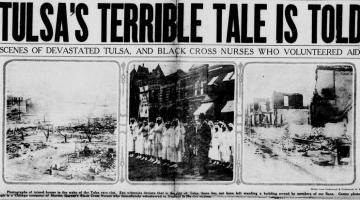 We are joined by Joe Torres to discuss the 1921 Tulsa Massacre and the media’s role in instigating the atrocity.
 Yurij Rudensky joins us to discuss a lawsuit against Galveston County, Texas, brought by Black and Latino residents over its racially discriminatory district map.
 Melanie Dominguez joins us to discuss the conditions in New York State jails and prisons and explain why new legislation to expand and strengthen the State Commission of Correction is needed.
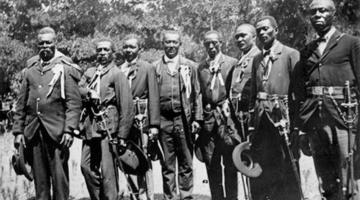 Giving Juneteenth the imprimatur of a state stamp of approval makes it problematic, and no longer the people’s holiday it has been for nearly 100 years.
 The Biden administration and congress work together in their efforts to secure what they think is U.S. domination. They are playing a dangerous game and now try to bring back a draft through sleight…


