A Black Agenda Radio commentary by executive editor Glen Ford
Detroit’s voteless citizens are registering their written objections to the state-imposed financial dictator’s plans to restructure the city, in bankruptcy court. Activists say Detroit’s “deep debt is rooted in ‘misguided and racist decisions by Wall Street bankers and regional corporate elites’ – but the poor, mostly Black city is being made to pay.”
The “People's Plan” to Save Detroit
A Black Agenda Radio commentary by executive editor Glen Ford
Detroit is encircled in a courtroom full of corporate barracudas.”
When the state of Michigan disenfranchised the people of Detroit and imposed bankruptcy lawyer Kevyn Orr as emergency financial dictator, the corporate vultures licked their chops in anticipation of a feast. Bankruptcy court is a predatory corporate habitat, the antithesis of anyone’s notion of democracy. Detroit isn’t even allowed to have its own lawyer, but is instead represented by the same corporate firm, Jones Day, that has represented many of Detroit’s corporate creditors. And those Jones Day lawyers answer, not to Detroit’s powerless city government, but to Kevyn Orr, the state-imposed financial dictator. Detroit is encircled in a courtroom full of corporate barracudas – some of whom pretend to be the city’s lawyers.
The grassroots activist organizations D-REM, Detroiters Resisting Emergency Management Moratorium Now! Coalition already flooded
The activist groups oppose paying anything to the predatory banks.”
The activists say what’s going on in bankruptcy court has little to do with the real causes of Detroit’s crisis, which “results from decades of revenue decline caused by redlining, housing discrimination and deindustrialization.” Detroit’s deep debt is rooted in “misguided and racist decisions by Wall Street bankers and regional corporate elites” – but the poor, mostly Black city is being made to pay.
Since Kevin Orr and the Jones Day lawyers cannot be trusted, the activists ask that Judge Rhodes appoint a trustee to look after the city’s interests. The judge should also call into question the land use and development schemes Kevyn Orr has already put in motion, giving valuable Detroit property away to corporate developers even as the city is starved for funds. They want Judge Rhodes to halt Kevyn Orr’s efforts to regionalize or privatize Detroit’s water treatment facilities – which have long been coveted by corporations. And, the activists emphasize that public transportation is key to the city’s revitalization.
But nothing – nothing! – is as important as democracy, from which the legitimacy of any plan for the city must flow. As D-REM has written: “ Detroit’s rebirth will be the result of the People’s unrelenting demand for democratic self-governance” and “equal access to and management of the natural and economic resources of the city.” They have formulated a “People’s Plan
For Black Agenda Radio, I’m Glen Ford. On the web, go to BlackAgendaReport.com.
BAR executive editor Glen Ford can be contacted at Glen.Ford@BlackAgendaReport.com .

 In this series, we ask acclaimed authors to answer five questions about their book. This week’s featured author is Atiya Husain. Husain is Associate Professor of Africana Studies at Williams College…
 The Black Radical Tradition is the rich legacy passed down by revolutionaries. It is an important tool today as we struggle to turn the Americas into a Zone of Peace.
 The trial of former Peruvian president Pedro Castillo, the victim of a 2022 lawfare-style coup, has begun. The legal process used against him is a sham covering up the human rights abuses…
 Trump administration interference in Panama has brought about a reckoning on migration and human rights throughout the region. These issues can no longer be ignored.
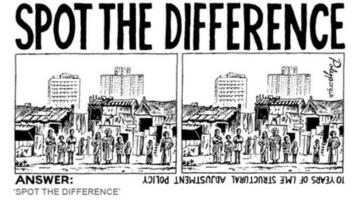 Presenting new research, Dylan Sullivan and Jason Hickel mount a devastating critique of the impact of structural adjustment in Africa in the 1980s and 1990s. Drawing on recent data on Africa’s…


