There are connections between spiritual and political beliefs. The writer advises, "...consider the synergy between the principles of our faith and the revolutionary spirit of communism."
Originally published in Hood Communist.
Ibn Umar reported: The Prophet, peace and blessings be upon him, said:
“The most beloved people to Allah are those who are most beneficial to people. The most beloved deed to Allah is to make a Muslim happy, or remove one of his troubles, or forgive his debt, or feed his hunger. That I walk with a brother regarding a need is more beloved to me than that I seclude myself in this mosque in Medina for a month. Whoever swallows his anger, then Allah will conceal his faults. Whoever suppresses his rage, even though he could fulfill his anger if he wished, then Allah will secure his heart on the Day of Resurrection. Whoever walks with his brother regarding a need until he secures it for him, then Allah Almighty will make his footing firm across the bridge on the day when the foundations are shaken.”
As-Salaam Alaikum Warahmatullahi Wabarakatuh, and Ramadan Kareem to those of you observing this blessed month.
If you’ve been keeping up with our book club posts on Safiya Bukhari’s ‘The War Before’, you are aware that I find her synthesize of Islam and revolutionary politics to be incredibly inspiring. For her, there is no tension between the ideals of Islam and the ideals of communism; both share principles of collectivism, fearlessness, and submission to a larger power, among other commonalities.
Thinking about this during Ramadan, reading the Quran and Hadith daily while continuing to organize, I can’t help but analyze the connections. As we break our fasts and perform our good deeds, it’s important to reflect on the teachings of our beloved Prophet Muhammad (peace and blessings be upon him) and consider the synergy between the principles of our faith and the revolutionary spirit of communism.
At the heart of both communism and Islam is an unwavering commitment to social justice, equality, and the well-being of our fellow humans. The hadith I’ve shared above demonstrates this beautifully:
“The most beloved people to Allah are those who are most beneficial to people…”
From the very beginning, Islam has emphasized the importance of compassion, empathy, and community. The early days of Islam offer numerous examples and anecdotes that demonstrate these values in action. One powerful example of compassion and empathy in Islam is the story of the Prophet Muhammad (PBUH) and the elderly woman who would throw trash on him. As he walked through the streets of Mecca, an elderly woman would consistently throw garbage on him to humiliate and insult him. Despite her ill-treatment, the Prophet never retaliated or rebuked her. One day, when the woman didn’t appear, the Prophet went to her house to inquire about her health. The woman was shocked by his kindness and concern, which led her to recognize the true nature of his message and embrace Islam. This story highlights how the Prophet’s compassion and empathy transformed a hostile situation and changed someone’s heart — and equally important, it shows the Prophet’s deep sense of community.
Another example of the importance of community in Islam is the formation of the first Muslim community in Medina, known as the Muhajirun (emigrants) and the Ansar (helpers). When the early Muslims from Mecca migrated to Medina to escape persecution, the local Medinan Muslims, the Ansar, welcomed them with open arms. They shared their resources, homes, and even their wealth to ensure the well-being of their brothers and sisters in faith. This event, known as the Hijra, marked the establishment of the first Islamic community, where the values of compassion, empathy, and unity were put into practice.
Likewise, communism seeks to build a classless society where resources and wealth are distributed according to each person’s needs, ensuring no one is left behind. This vision of an egalitarian society is embodied in Marx’s famous maxim, “From each according to his ability, to each according to his needs.” To illustrate this principle, let’s consider two examples from history.
One example can be found in the early days of the Soviet Union. In the wake of the October Revolution, the new Bolshevik government implemented policies aimed at improving the lives of ordinary citizens. One such policy was the establishment of communal kitchens, or “public stolovayas.” These kitchens provided free or affordable meals to workers, students, and others in need, ensuring that even the poorest members of society had access to nourishment. By providing for the basic needs of its citizens, the Soviet government sought to create a society where everyone had an equal chance to thrive.
Another example can be seen in the Cuban Revolution. After seizing power, Fidel Castro and his comrades quickly embarked on a sweeping program of reforms aimed at reducing inequality and improving the lives of the Cuban people. One of the most significant initiatives was the 1961 Cuban Literacy Campaign. Prior to the revolution, illiteracy rates in Cuba were alarmingly high, particularly in rural areas. In response, the new government mobilized more than 100,000 volunteer teachers to travel across the country, providing free education to people of all ages. The campaign was a resounding success, reducing the illiteracy rate to less than 4% in just one year.
These examples illustrate the communist principle of distributing resources and wealth according to each person’s needs, with the ultimate goal of ensuring that no one is left behind. While both the Soviet Union and Cuba each faced their own unique challenges, these stories serve as powerful reminders of the transformative potential of a society rooted in the principles of social justice, equality, and mutual aid – values that resonate deeply with the teachings of Islam.
During Ramadan, we are reminded of our duty to give zakat, or almsgiving, as well as perform acts of kindness for those less fortunate. Similarly, communism recognizes the necessity of a collective effort to uplift and empower the vulnerable.
As the hadith states:
“…or remove one of his troubles, or forgive his debt, or feed his hunger…”
This portion of the hadith echoes the communist principle of mutual aid. In both Islam and communism, we are called to be active participants in creating a better world by helping our neighbors and alleviating their suffering. We are taught to put the needs of others before our own personal interests, fostering a sense of unity and camaraderie.
The essence of this statement lies in the idea that our actions hold more weight than our words. Engaging with the world, supporting our brothers and sisters, and working towards the betterment of society are what truly define our faith and our commitment to justice. This sentiment is echoed by El-Hajj Malik El-Shabazz (formerly Malcolm X), who once said, “When ‘I’ is replaced with ‘we,’ even illness becomes wellness.”
As Muslims, we strive to be positive forces within our communities. And with a strong emphasis on our actions, we aim to bring happiness and relief to those in need. Communism, too, seeks to create a society where everyone is taken care of, and where each individual has an active role in fostering the well-being of their neighbors, primarily through actions.
In both Islam and communism, there is a profound understanding that our collective strength comes from our ability to support one another; this is why both share a commitment to actions over mere words. In Islam, our faith is not only demonstrated through our beliefs but also through the fulfillment of the Five Pillars, which require active community participation and commitment to serving Allah by serving our fellow human beings. Similarly, communism demands that we move beyond mere rhetoric and work collectively to dismantle systems of oppression and create a just society. This shared focus on the transformative power of action highlights the importance of engaging with our communities and striving for positive change. It is through our deeds, not just our words, that one can truly embody the principles of Islam and communism.
Just as we stand together during our daily prayers, we are also called to stand together in the face of oppression. As we continue our journey through Ramadan, let’s remember the teachings of our beloved Prophet Muhammad (PBUH) and the shared values of social justice and equality that connect our faith with the revolutionary ideals of communism; it is through these ideals that Islam softens hearts; it is through these shared principles that we can bridge the gap between the spiritual and the material, infusing our lives with a sense of purpose and commitment to a greater good.
In this holy month, may we strive to be of service to others, to give without expectation of return, and to practice empathy and understanding in our interactions. Let us embody the spirit of Ramadan by fostering connections, both within our communities and across ideological divides, to build strong and resilient networks of support that transcend borders and barriers.
Furthermore, let us use this sacred time as an opportunity to reflect on the ways in which our faith and our commitment to liberation can inspire us to work towards a world where every person’s needs are met. As Muslims, we are called to be agents of change, to challenge systems of oppression, and to uplift the most marginalized among us — it is this call, in fact, that first attracted me to the faith.
As we fast and pray during this blessed month, let us also remember to take action. And for those who do not practice, let this month similarly be a time of reflection, and take any chances you have to support your Muslim comrades. Our faith, like our political ideals, must be manifested through our deeds.
Musa is a cultural worker, community organizer, and independent researcher. They are a member of the Walter Rodney Foundation, and host of the Groundings podcast.

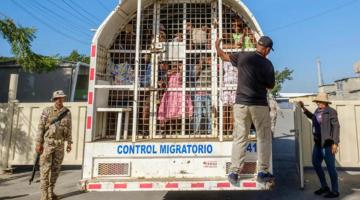 The reactionary government of the Dominican Republic has continued to pursue its racist policies against Haiti, deporting Haitians while exploiting the nation for its economic gain. Widespread sexual…
 Florida’s ban takes effect May 1, 2024, and the fate of Arizona’s abortion access is in the throes of legal, political, and legislative battles.
 President Bola Tinubu’s lifting of fuel subsidies and liberalization of currency trade has pleased the IMF and increased hunger in Africa’s most populous country.
 Incarcerated People in Texas Weather Extreme Heat in non-Air Conditioned Prisons.
 We revisit BAR’s 2017 analysis of the protection afforded Rwanda’s Paul Kagame by the human rights industrial complex and continue our discussion with BAR’s poet in residence about his upcoming…


