“In the latter half of the 20th century, black women theorists offered critical insight into how we might develop emancipatory strategies.”
With the rise of Trump’s authoritarianism, the FBI’s recently leaked memo labeling anti-police brutality protesters as “Black Identity Extremists,” and the increased militarization of ICE and Border control, many are searching for strategies to combat the newest wave of authoritarianism. Activists and scholars often look to the writings and speeches of major leaders of the 1960s and 1970s—Malcolm X, Frantz Fanon, and Stokely Carmichael—among others, for insight on how to organize today. To be sure, these leaders can inform our contemporary organizing approaches. However, there is a broader intellectual and activist tradition from which we can draw. In order to combat current manifestations of white supremacy and imperialism, it is important to widen our cannon. This can be achieved, in part, by re-examining black women thinkers who have provided us with a rich and expansive genealogy of liberation theories. In the latter half of the 20th century, black women theorists offered critical insight into how we might develop emancipatory strategies that are ideologically flexible, gender inclusive, and global in scope.
Mid-century black women radicals often emphasized the importance of developing an elastic ideological and activist praxis. This group of theorists, which included Claudia Jones, “Queen Mother” Audley Moore, Vicki Garvin, and Louise Thompson Patterson among others, honed their organizing and theorizing skills in the 1920s and 1930s in organizations such as the Universal Negro Improvement Association (UNIA) and the Communist Party (CPUSA). By the 1940s they were leading members of what scholars have called the “Black Popular Front,” or a coalition of progressive and radical groups organizing for civil rights. Committed to black, working-class, and women-centered ideas of liberation, many of these activists found existing organizations productive but insufficient for their visions of liberation. As a result, they developed their own organizing practices that combined multiple ideological and activist ideals.
“Committed to black, working-class, and women-centered ideas of liberation, many of these activists developed their own organizing practices.”
Many of the aforementioned activists joined the Sojourners for Truth and Justice, a radical black women’s group formed in 1951. Moving beyond organizations guided by a singular ideological framework or limited activist strategies, Garvin, Jones, and others developed what scholar Mary Helen Washington has called “black left feminism,” or a politics that combined nationalist and Marxist positions on race and class with a form of mid-century black feminism. The Sojourners implemented this theoretical framework through a range of activities. At times, they employed the strategies of middle-class black women, championing black women’s dignity and respectability in the press. At other moments, they drew on Marxist critiques and strike organizing to support black women workers. Whatever form the Sojourners’ organizing took, it was defined by black women’s ideas and needs rather than rigid ideological aims. The Sojourners serve as a reminder that debates about ideological clarity should not cloud political organizing and that some of the most productive ideological frameworks develop out of theorizing at the intersection of multiple strains of political thought.
If some black women activists emphasized ideological malleability, then others focused on gender inclusivity. This practice was prominent among women in the Black Panther Party. Women joined Newton and Seale’s organization in 1967, the year after it was founded, because they were attracted to the group’s evolving ideological framework which included commitments to black nationalism, socialism, and internationalism. Panther women were also committed to theorizing and practicing gender inclusive forms of the Panthers’ tenets. Some, like Gayle Dickson and Tarika Lewis, created artwork that represented black women engaged in black power and internationalist activism. Others, published articles like the “Black Revolutionary Woman” and “Message to Revolutionary Women” in which they foregrounded the importance of interpreting the Panthers’ theories in gender-specific ways. Through their artwork, articles, and activism, Panther women successfully reshaped Party conversations and dynamics, eventually pushing organizational leaders to be among the first to publically endorse women’s rights and gender equality. Looking beyond Newton and Seale, and including Panther women’s production in our current theoretical cannon, can be instructive for developing emancipatory models that are inclusive and intersectional in scope. It can also help us ward off the sexism and exclusion that undermined past movement efforts.
“Panther women successfully reshaped Party conversations and dynamics.”
Other black women activists explicitly focused on theorizing liberation on a global scale. The Third World Women’s Alliance (TWWA) exemplified this practice. The organization developed out a women’s caucus within the Student Non-Violent Coordinating Committee (SNCC), which, by the late 1960s, championed a globally minded, anti-imperialist position expressed through Black Power politics and rhetoric. TWWA leaders envisioned the group as a collection of “black and other third world women” working together to fight “all forms of racist, sexist, and economic exploitation.” Through a litany of editorials, articles, interviews, and artwork in their newspaper, Triple Jeopardy, members developed an ideological platform and activist agenda predicated on the commonalities among women of color at home and abroad. They formed alliances with women in Cuba and Vietnam, developed cross-cultural reproductive rights campaigns, and formulated workers strikes that targeted companies engaged global imperialist oppression. Members undergirded their activism with an intersectional ideological approach. They proclaimed that they saw no “contradiction in being nationalists, in being feminists, and in being socialists” and mobilized against forces that epitomized racism, sexism, and imperialism around the world. The TWWA foregrounded the importance and usefulness of viewing black liberation in a global context and the potential of ideological exchanges among people of color worldwide. Such a perspective can help us develop approaches that simultaneously take into account the international and insidious scope of imperialist forces and the myriad ways in which people of color can work together.
“Third World Women’s Alliance proclaimed that they saw no “contradiction in being nationalists, in being feminists, and in being socialists.”
The reinvigorated right requires that we revamp our strategies to combat it. We should also ensure that we recognize the pitfalls and shortcomings of previous emancipatory strategies—namely that a commitment to ideological purity above practically, patriarchy above widespread empowerment, and regional particularity above global solidarity. One of the primary ways in which we can achieve this goal is to expand our understanding of potential theoretical and programmatic approaches to black liberation. My new book, Remaking Black Power: How Black Women Transformed an Era, examines these and other black women activists’ political and intellectual thought in an effort to diversify our tactics and frameworks. It centers black women’s ideas and activism in order to foreground how they might help us rethink the historical and historic uses of Black Power and black radicalism in addressing all facets of oppression—old, new, and reconstituted. The black radical tradition best counters white supremacist patriarchy when we acknowledge and employ the multiplicity of freedom dreams that black women and men created. Returning to the theories of black women radicals can reveal new sites of theoretical and organizational possibilities and shine light on the ways that we might move toward differently constituted futures.
Ashley Farmer is Assistant Professor of History and African American Studies at Boston University. Her first book, Remaking Black Power: How Black Women Transformed an Era, will be published in November 2017 as part of the University of North Carolina Press’s Justice, Power, and Politics Series. You can follow her on twitter @drashleyfarmer

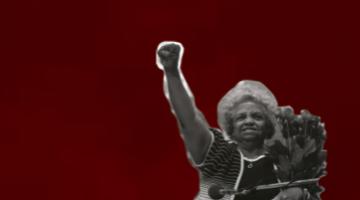
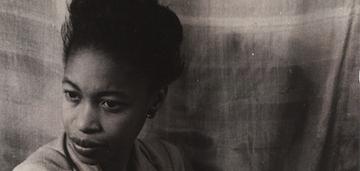 Margaret Walker was an intellectual of the highest order. Her uncompromising critiques of Black art, Black leadership, and the US racist oligarchy are sorely needed today.
 Anya Parampil’s book tells the story of US hybrid warfare on Venezuela and of the tectonic social and economic shifts reshaping the world today.
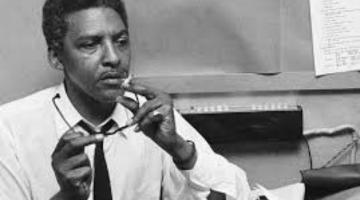 The recent Obama-produced retelling of the life and work of Bayard Rustin is better judged by what it leaves out - his legacy of counterrevolutionary action designed to defang radical movements.
 The International Department of the Central Organizing Committee of the Communist Party of Kenya issued a statement of support in response to the recent decision from the Kenyan High Court declaring…
 Israel's genocide in Gaza is now a litmus test for Black voters, and clergy are warning Joe Biden that he risks losing their support as his approval rating continues to fall in an election year.…


