The Year of W.E.B. Dubois
Mumia Abu Jamal, the nation’s best known political prisoner, marked the 150th anniversary of W.E.B. Dubois’ birth with a special message. “For today’s scholars in history and sociology, his texts remain required reading, just as Freud’s remain central to modern psychology,” said Abu Jamal, in an essay for Prison Radio. The Philadelphia City Council has named 2018 “The Year of W.E.B. Dubois,” who early in his career as a scholar-activist authored a groundbreaking study of the city’s Black population.
Dubois: Activist and Educator
Philadelphia’s Saturday Free School kicked off a year of activities celebrating W.E.B. Dubois’ life and work with a symposium at the Church of the Advocate. “Dubois developed some of the deepest theories when it comes to understanding the human condition,” said public school teacher and Free School activist Ismael Jimenez. “He’s measuring your soul against the tape of a world that looks on with amused contempt and pity.” Black Agenda Report executive editor Glen Ford told the crowd: “Dubois believed that Black labor was the central force of the Black movement, and was also the most revolutionary component of labor in the United States.”
Dollar to Get Knocked Off Its Pedestal
Duboisian scholar and activist Dr. Anthony Monteiro said the Chinese yuan will topple the dollar from its artificial position as the world’s reserve currency. The rise of the yuan “will redefine the entire architecture of global trade and the relationship of currencies” and “end the special, exorbitant privileges that the U.S. dollar has held since 1971,” when President Nixon took the U.S. off the gold standard.
Sundiata Acoli’s “Affirmation”
Political prisoner Sundiata Acoli, who was arrested with fellow Black Panther Assata Shakur in 1973, is among a host of political prisoners and activists that took part in a reading of Shakur’s poem, “Affirmation,” written in exile in Cuba. Acoli will not be eligible for parole until 2032, when he will be 94 years old. “Affirmation” reads, in part: “I have been locked up by the lawless, handcuffed by the haters, gagged by the greedy, and if I know anything at all, it’s that a wall is just a wall…it can be broken down.”
Black Agenda Radio on the Progressive Radio Network is hosted by Glen Ford and Nellie Bailey. A new edition of the program airs every Monday at 11:am ET on PRN. Length: one hour.

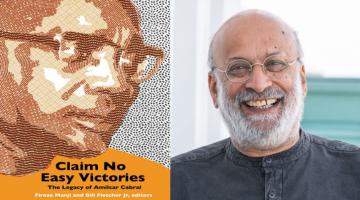 In this series, we ask acclaimed authors to answer five questions about their book. This week’s featured author is Firoze Manji. Manji, a Kenyan with more than 40 years’ experience in…
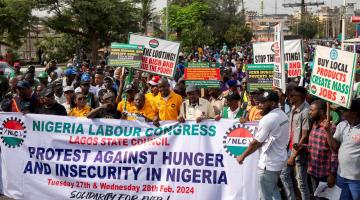 A false narrative of "Christian genocide" is being weaponized against Nigeria, which is itself victimized by western neo-colonial policies.
 The cause of the explosion at Mitchel Houses in the South Bronx harkens back to the arson-for-profit schemes of the 1970s that caused mass destruction of Black and Latine communities. Decades later,…
 The A.I. boom is on the verge of bursting like every other capitalist bubble. Financialization and speculation will result in another economic crisis.
 On the southern shore of Lake Maracaibo, communards sustain themselves by fishing, but just as much through practices of solidarity.


