Creating alternative spaces for Black people to gather free from interruption or regulation.
BAR Book Forum: Sarah Jane Cervenak’s Book, “Black Gathering”
Roberto Sirvent, BAR Book Forum Editor
In this series, we ask acclaimed authors to answer five questions about their book. This week’s featured author is Sarah Jane Cervenak. Cervenak is Associate Professor of Women's, Gender, and Sexuality Studies and of African American and African Diaspora Studies at the University of North Carolina, Greensboro. Her book is Black Gathering: Art, Ecology, Ungiven Life.
Roberto Sirvent: How can your book help BAR readers understand the current political and social climate?
Sarah Jane Cervenak: I wonder if the book will help readers rethink the reach of what figures as the political and social climate. When I first read the question, I thought well the climate is outside the book and often, as a concept, evokes the extraliterary world. But even still, the worlds traced and shaped in Black literary and aesthetic production often teach us that books are their own ecosystems, that they can be climactic openings within what’s often otherwise, repressive anti-black, anti-queer, anti-disabled, patriarchal political climates.
Poet Dionne Brand begins her incomparable book The Blue Clerk (2018) with the following words—“stipule, a small leaf-like appendage to a leaf” (3). This phrase precedes what she sees as attending to but also as what’s withheld from the writing. Throughout the collection, poems are accompanied by uncategorized leafy greens, lists of all that is or might be purple in the world. When I was reading The Blue Clerk I thought, this book seems to begin an earth next to this one, a shadow planet where nothing is held, categorized, broken. In that way, her book makes climate; it’s never not climactic.
I believe that Black women writers have long earthed in writing, have long stretched climate enough so that it becomes a page, a dwelling place between punctuation, another locale to experience togetherness. I hope that my book, in its small way, expresses that understanding and relearning of the concept of political climate and offers some tender places for reprieve for those who are besieged by the atmosphere outside the book.
What do you hope activists and community organizers will take away from reading your book?
To be honest, I struggled with this question, motivated as I am by feminist and disability studies scholars putting pressure on ideas of activism, on action, on the shapes and traces of community support as visible, knowable, and as maybe extra-literary. The writers and artists I engage in this book might not be said to be activists. What is more, there are books better than mine that engage, center and honor environmental justice activists and who ask great questions on environmental justice activism. I’m thinking of Dr. Chelsea Mikael Frazier’s work on Black Feminist ecology. But, as is often the case, answers or thoughts about questions arrive, for me, late at night. Lines from poems show up at 3 am and then I find myself turning a question I didn’t think I had anything helpful to say about around like one turns a crystal. There’s this great line from Aracelis Girmay’s poem The Black Maria (2016): “and so to tenderness I add my action” and then from Toni Cade Bambara, “writing is one of the ways I participate in transformation.” Thinking about Girmay and Bambara’s words, I hope that my book arrives as tenderness, as a helpful action and as both at the same time.
We know readers will learn a lot from your book, but what do you hope readers will un-learn? In other words, is there a particular ideology you’re hoping to dismantle?
What I offer, I hope, is another occasion to rethink how the word give circulates in language, particularly when inflected by cruel feelings. When the word give moves by a notion of anti-black and anti-earth beneficence and when it moves in the interest of life’s differential categorization, separation, and along scales of violent gathering as extraction, owing and owning, then maybe it needs to be rethought, respun, experimentally imagined along the lines of its opposite inflection, ungives.
I’m curious about the other forms of relationality that emerge in unfettered gathering, as they’ve long been theorized by Black aesthetic and literary practice…when the earth is imaginatively released from empirical and epistemological desires. What if we maybe tried to unlearn the earth toward earth toward pangea toward some geological otherwise? What if then?
Also, what if the unlearning of the earth is also an unlearning of art and environment, the forms it is said to take and the relations it’s said to harbor. I feel like my entire intellectual career is driven by not knowing, by asking after the traces of unlearning but in refining the asking so much so that asking recedes into cabinets. By refining the asking so much that, something else flourishes.
Who are the intellectual heroes that inspire your work?
I admire so many artists and writers, poets and painters, the questions of children. My son asks great questions. I’ll start with him. My mom helps me rethink words. Among this cadre of askers, dreamers and thinkers, there is Gayl Jones, Lorna Simpson, Toni Morrison, Fred Moten, Jean-Thomas Tremblay, Renee Gladman, Mercy Romero, Christina Sharpe, Keguro Macharia, La Marr Jurrelle Bruce, Tiffany King, Rachel Zolf, Amirio Freeman, Jennifer Nash, J. Kameron Carter, Chelsea Frazier, Gayle Solomon, fahima ife, Joshua Bennett, Avery Gordon, Erin Manning, Denise Ferreira da Silva, Tina Campt, Nikki Wallschlaeger, Xaviera Simmons, Gabrielle Ralambo-Rajerison, Samiya Bashir, Leonardo Drew, Clementine Hunter, Saidiya V. Hartman, Dionne Brand, Aaron Boothby, Petero Kalulé, Torkwase Dyson, Toni Cade Bambara, Kevin Quashie, Jeanne Vaccaro.
In what way does your book help us imagine new worlds?
Not sure. The poets I engage are already doing it and I’m amazed by that. I read Renee Gladman’s books and she like literally architects cities not just imagistically but by how she puts words down. I hope my book helps you travel like Gladman’s book does. I hope it arrives in your mind as a good feeling, as a sentence or two that’s helpful, as a page that becomes a city or a garden or a park bench. I hope it sits next to that painting in your memory. Like that poem by Rick Barot, “Child Holding Potato” (2015), where the narrator describes travelling to cities to stare at paintings after learning of his sister’s unnamed “diagnosis.” Also, that scene in Gayl Jones’ s Mosquito (2000) where the main character sits with a painting, following its lines somewhere. I hope this book helps you travel like paintings, ambles like and alongside the unexpected, unelaborated appearance of them in your mind and in your heart. I hope for all of those things.
Works referenced:
Barot, Rick. 2015. “Child Holding Potato.” New York Times Magazine.
Brand, Dionne. 2018. The Blue Clerk. Durham: Duke University Press.
Girmay, Aracelis. 2016. The Black Maria. Rochester: BOA Editions, Ltd.
Jones, Gayl. 2000. Mosquito. Boston: Beacon Press.
Roberto Sirvent is editor of the Black Agenda Report Book Forum.

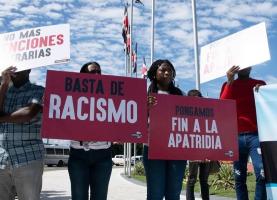 The Dominican Republic’s racist President is once again scapegoating Haitians and Dominicans of Haitian descent for his government’s terrible economic policies. This time, his target is poor pregnant…
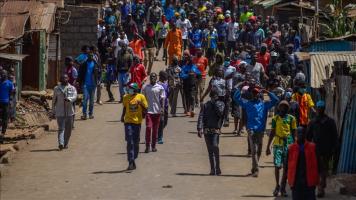 Kenyans have been protesting President William Ruto’s Finance Act that increases taxes on essential goods while making concessions to foreign capital.
 Quiet as it’s kept, the African continent is the most susceptible to the impacts of climate change. And it has a history of colonialism, capitalist extraction, and labor exploitation to blame for…
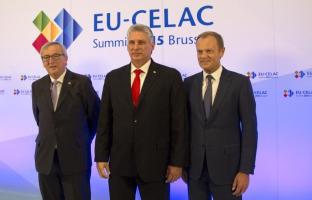 The European Union failed to bully the members of the Community of Latin American and Caribbean States (CELAC) into renouncing its neutral stance on the Ukraine conflict.
 Opposing the latest call for the invasion of Haiti, ending legacy admissions in New York, felony murder sentencing in Pennsylvania.


