In this series, we ask acclaimed authors to answer five questions about their book. This week’s featured author is Crystal Eddins. Eddins is Assistant Professor of Africana Studies at UNC Charlotte. Her book is Rituals, Runaways, and the Haitian Revolution: Collective Action in the African Diaspora (available open access).
Roberto Sirvent: How can your book help BAR readers understand the current political and social climate?
Crystal Eddins: Rituals, Runaways, and the Haitian Revolution: Collective Action in the African Diaspora focuses on the networks of solidarity that enslaved people, maroons, and free people of color formed in various social spaces during the years prior to the Haitian Revolution of 1791-1804. The book’s eight chapters trace the development of colonial Haiti’s culture of subversion by examining the trans-Atlantic slave trade and conditions of enslavement, maroons and enslaved people’s social networks and sacred practices, and patterns of resistance over time that led to the 1791-1804 revolution. More broadly, the book highlights Haiti’s role and significance to the modern world as a site that was central to the beginning of racial capitalism and European colonialism. Conversely, the book shows how Haiti’s tradition of resistance since the fifteenth century was and remains central to the Black Radical Tradition, the long-term, transnational struggle against global capital, anti-Blackness, imperialism, violence and death. Since 2018, Haitians have been engaged in an ongoing struggle against government corruption, police and gang violence, rising food and gas prices, and low wages. These patterns of exploitation in Haiti are connected to a global consolidation of white supremacist capitalism, and are rooted in histories of colonial extraction and racial slavery. As we have seen Black protest movements emerge across the U.S., South America, and Africa in recent years, it becomes important to think about not only the successes of the Haitian Revolution but also the ways Black uprising is critical to transforming the world.
What do you hope activists and community organizers will take away from reading your book?
Just as much as Rituals, Runaways and the Haitian Revolution is a historical project, it also is a sociological exploration of the inner-workings of movements, revolutions, and other forms of collective action. I hope that activists and community organizers will find some of the social movement theory to be helpful. The book attempts to explain how people who share material conditions develop a politicized shared consciousness, and build networks of solidarity that shape their collective resistance efforts. It broadly suggests that what people know is important in mobilizations, that Black people already know things within their cultural repertoire that are keys to their liberation, so how do we put those tools together? For example, Chapter Three emphasizes the ways enslaved people and maroons participated in ritual gatherings and engaged in other cultural practices such as martial arts dances to develop collective identity and solidarity, and to arm themselves with sacred armaments that aimed to counter the violence of slavery. Chapter Four examines how maroons from various African ethnic backgrounds forged solidarities across religious, regional, and linguistic lines. Further, the book shows the importance of understanding the changing nature of material conditions such as the maroons who adjusted and developed new tactics in the face of growing sugar and coffee economies and violent state-sponsored repression. As people recognize the factors that lead to moments of crisis that contribute to windows of opportunity, the power of people to exploit and take advantage of those moments can advance revolutionary agendas. I also hope that people will be inspired by not only the Haitian Revolution itself, but the kinds of political possibilities that happen when people reclaim themselves from the mechanisms of their oppression.
We know readers will learn a lot from your book, but what do you hope readers will un-learn? In other words, is there a particular ideology you’re hoping to dismantle?
I hope that general readers of the book will unlearn the harmful narratives about Haiti that have pervaded western media and knowledge production for centuries. As Michel-Rolph Trouillot, Gina Athena Ulysse, and other Haitian Studies scholars have already and more clearly articulated, the public perception of Haiti as a failed state as well as its economic and political troubles are directly connected to French colonialism and racial slavery as well as the twentieth century U.S. military occupation. Key to dismantling these narratives about Haiti is the work of dismantling the idea of the “negro” – or what Cedric Robinson describes as Europeans’ racialized fabrication of the trans-Atlantic slave trade. The “negro” was void of ethnic, cultural, political, or linguistic distinctions, but refuting the idea of African people as empty vessels who disembarked in the Americas is central to African Diaspora studies, as is identifying the heritages, legacies, practices, and lifeways that now make up the various cultures of the Black Atlantic. The book also tries to reduce or eliminate the dichotomies that some scholarship creates between enslaved people and maroons who often were in collaboration with each other. Finally, and perhaps most importantly, my hope is that the book will help dismantling the idea of political impossibilities. The extremity of violence and death that characterized colonial plantation society repressed the enslaved population to the degree that the Haitian Revolution was supposed to have been impossible – yet it happened, and these conditions were part of what triggered revolutionary unrest. The lesson that we can come away with is that the political outcomes that we want but that seem out of reach – such as climate justice, reproductive justice, reparations, prison abolition, the end of imperialism – are not impossible with the right solidarities and the right timing.
Which intellectuals and/or intellectual movements most inspire your work?
The work of Cedric Robinson influenced my interest in the connections between the subordination and exploitation of enslaved peoples’ lives and labor as the major force behind capitalist development and pretext for their strivings for freedom. Ruth Simms Hamilton was a sociologist at my alma mater, Michigan State University, and developed a framework for studying the global African Diaspora that also informs my interest in enslaved Africans’ cultural heritages and autonomous social spaces in place like Haiti and the broader Atlantic. Other scholars like Anna Julia Cooper and C. L. R. James, have influenced my interest in how the Haitian Revolution transformed the modern era. Then scholarship by Carolyn Fick, Michael Gomez, Stephanie Camp, and Jean Fouchard helped shape the way I think about the significance of maroons using historical documents, primarily runaway slave advertisements, as sources that originally were used to surveil and re-enslave Black people but can be subverted to highlight agency and self-liberation. Finally, Haitian scholars like Rachel Beauvoir-Dominique and Jean Casimir help me bring attention to the Haitian people’s long-term struggle for survival and liberation since the late fifteenth century, which has manifested over time as marronnage, protest, and revolution; the religion of Haitian Vodou and the Kreyol language; and the lakou system of mutual aid and communal living and work.
Which two books published in the last five years would you recommend to BAR readers? How do you envision engaging these titles in your future work?
The first would be The Common Wind: Afro-American Currents in the Age of the Haitian Revolution by Julius C. Scott, published in 2018 by Verso Books. This is a fairly popular text in Black Studies and Atlantic history for the way it reveals how knowledge of the Haitian Revolution spread through enslaved, maroon, and free Black people’s communication networks throughout the Atlantic, including places like Jamaica, Cuba, Curacao, and Colombia. A major lesson from this text is that even in the dire circumstances of enslavement, the enslaved were aware of the geo-politics that shaped their lives and sought to take advantage of opportunities to revolt. The communication networks that enslaved people formed in market places, plantation labor gangs and living quarters, and in nighttime sacred gatherings helped to foster a growing sense of radical Black identity and solidarity. I think BAR readers will find this book helpful in thinking about the relationship between the growth of capitalism and the inevitability of Black revolt, and the important role of communication through media and other means of raising revolutionary consciousness. A second book that I would recommend is Histories of Racial Capitalism, edited by Destin Jenkins and Justin Leroy, published in 2021. Its chapters range in time periods, geographic locations, and topical themes, but each deploys and provides an accounting of racial capitalism and its connections to colonialism and the potentials of Black liberation.
Roberto Sirvent is editor of the Black Agenda Report Book Forum.







 Three years into Israel's genocide in Gaza, the consequences of a decision driven by siege, settlement expansion, and assaults on Al-Aqsa are still unfolding.
 In this week’s segment we hear about the right-wing politics of the anti-migrant movement in South Africa, ANC failures, and upcoming elections in that country. But we begin with the first and only…
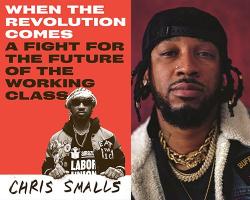 Chris Smalls discusses his memoir, "When the Revolution Comes: A Fight for the Future of the Working Class," published by Penguin Random House. He is the first and only union leader to successfully…
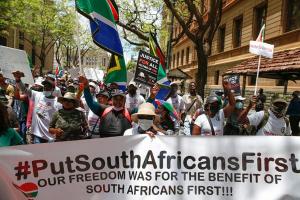 Our guest is Nairobi based political writer and strategist Clinton Nzala. He joins us to provide an update and an analysis of the South African anti-migrant March and March movement, which is…
 The Hague Group’s goal is to “. . . take coordinated legal and diplomatic measures against Israel’s violations of international law.” But international law was never a reality.


